I used my blender for the first time tonight, to make carrot/potato/leek soup. As a main course, I made the risotto carbonara I'd written about previously. It was a smashing success. I didn't have any arborio, so I used basmati rice. I used the veggie stock from the soup to make the risotto. Really nice. I was dubious at the beginning because of the amount of stock I had to put in, but dayum, it's GOOD! I have a feeling this recipe is going to become a frequent feature in our diet. I also made the citrus cake to satisfy Katy's (and mine, to be honest) cake jones. A bit overcooked, but otherwise yummy. I'm still getting used to my oven, so things should only get better.
[Recipe] Citrus-glazed pound cake
1 1/2 cups all-purpose flour
1 teaspoon baking powder
1/2 teaspoon salt
1 cup (2 sticks) butter, softened at room temperature
1 cup sugar, plus 1/3 cup
4 eggs
2 teaspoons pure vanilla extract
1/4 cup lemon juice, plus 1/3 cup
Preheat the oven to 350 degrees F. Butter a 6-cup loaf pan and line it with parchment or waxed paper. In a medium bowl, combine the flour, baking powder, and salt.
In a mixer fitted with a whisk attachment (or using a hand mixer), cream the butter. Add 1 cup of the sugar and mix. With the mixer running at low speed, add the eggs one at a time. Add the vanilla.
Working in alternating batches, and mixing after each addition, add the dry ingredients and 1/4 cup of the lemon juice to the butter mixture. Mix until just smooth.
Pour into the prepared pan and bake until raised in the center and a tester inserted into the center comes out dry and almost clean (a few crumbs are OK), 65 to 75 minutes.
Meanwhile, make the glaze: In a small bowl, stir together the remaining 1/3 cup sugar and the remaining 1/3 cup lemon juice until the sugar is dissolved.
When the cake is done, let cool in the pan 15 minutes (it will still be warm). Run a knife around the sides of the pan. Set a wire rack on a sheet pan with sides (to catch the glaze) and turn the cake out onto the rack. Peel off the waxed paper.
Using a turkey baster or pastry brush, spread glaze all over the top and sides of the cake and let soak in. Repeat until the entire glaze is used up, including any glaze that has dripped through onto the sheet pan. Let cool at room temperature or, wrapped in plastic wrap, in the refrigerator (Well wrapped, the cake will last up to a week). Serve at room temperature, in thin slices.
ho hum
Slow day today. Katy is in Leicester to see some friends. I didn't tag along cause train fare would have been prohibitive considering that I haven't been paid yet. I spent a good part of the day doing housework – I'm so domestic these days it's scary. Did lots of laundry and washing up and gave myself a coffee headache. Go me. The weather has been british-standard. It was pissing earlier, and now it's bright and sunny. Windy as hell too – I'm beginning to call Cambs The Windy City. I just made myself fish & chips for dinner. Yum.
I'm boring even myself with this entry, so I'll stop now.
Note to self
The shuttles for Cambridge leave at 5:30 *sharp*.
This means that you're SOL if you're there at 5:32.
crap.
More icony goodness

it's friday 5PM and I'm going home :D
Hmmmmm, muffins!
I've just discovered that the muffins in the cafeteria are allergy-friendly certified nut free.
This makes me happy.
You can even send me muffins by mail.
Why am I not surprised
By Pamela R. Winnick
Weekly Standard | May 5, 2005
Several centuries ago, some “very light-skinned” people were shipwrecked on a tropical island. After “many years under the tropical sun,” this light-skinned population became “dark-skinned,” says Biology: The Study of Life, a high-school textbook published in 1998 by Prentice Hall, an imprint of Pearson Education.
“Downright bizarre,” says Nina Jablonski, who holds the Irvine chair of anthropology at the California Academy of Sciences. Jablonski, an expert in the evolution of skin color, says it takes at least 15,000 years for skin color to evolve from black to white or vice versa. That sure is “many years.” The suggestion that skin color can change in a few generations has no basis in science.
Pearson Education spokesperson Wendy Spiegel admits the error in describing the evolution of skin color, but says the teacher's manual explains the phenomenon correctly. Just why teachers are given accurate information while students are misled remains unclear.
But then there's lots that's puzzling about the science textbooks used in American classrooms. A sloppy way with facts, a preference for the politically correct over the scientifically sound, and sheer faddism characterize their content. It's as if their authors had decided above all not to expose students to the intellectual rigor that is the lifeblood of science.
Thus, a chapter on climate in a fifth-grade science textbook in the Discovery Works series, published by Houghton Mifflin (2000), opens with a Native American explanation for the changing seasons: “Crow moon is the name given to spring because that is when the crows return. April is the month of Sprouting Grass Moon.” Students meander through three pages of Algonquin lore before they learn that climate is affected by the rotation and tilt of Earth–not by the return of the crows.
Houghton Mifflin spokesman Collin Earnst says such tales are included in order to “connect science to culture.” He might more precisely have said to connect science to certain preferred, non-Western, or primitive cultures. Were a connection drawn to, say, a Bible story, the outcry would be heard around the world.
Affirmative action for women and minorities is similarly pervasive in science textbooks, to absurd effect. Al Roker, the affable black NBC weatherman, is hailed as a great scientist in one book in the Discovery Works series. It is common to find Marie Curie given a picture and half a page of text, but her husband, Pierre, who shared a Nobel Prize with her, relegated to the role of supportive spouse. In the same series, Thomas Edison, inventor of the light bulb, is shown next to black scientist Lewis Latimer, who improved the light bulb by adding a carbon filament. Edison's picture is smaller.
Jews have been awarded 22 percent of all Nobel Prizes in science, but readers of Houghton Mifflin's fifth-grade textbooks won't get wind of that. Navajo physicist Fred Begay, however, merits half a page for his study of Navajo medicine. Albert Einstein isn't mentioned. Biologist Clifton Poodry has made no noteworthy scientific discoveries, but he was born on the Tonawanda Seneca Indian reservation, so his picture is shown in Glenco/McGraw-Hill's Life Science (2002), a middle-school biology textbook. The head of the Human Genome Project, Francis Collins, and Nobel Laureates James Watson, Maurice H.F. Wilkins, and Francis Crick aren't named.
Addison-Wesley, another imprint of Pearson Education, is so keen on political correctness that it lists a multicultural review board of nonscientists in its Science Insights: Exploring Matter and Energy, published in 1994 but still in use. Houghton Mifflin says it overemphasizes minorities and women to “encourage” students from these groups. A spokesman for Pearson Education blames the states for demanding multiculturalism.
If it's the states that impose multiculturalism, however, they're only doing the bidding of the National Academy of Sciences. In 1995, the academy published the National Science Education Standards, which, according to academy president Bruce Alberts, “represent the best thinking . . . about what is best for our nation's students.” The standards (which explicitly place religion on a par with “myth and superstition”) counsel school boards to modify “assessments” for students with “limited English proficiency” by, for example, raising their scores. They tell teachers to be “sensitive” to students who are “economically deprived, female, have disabilities, or [come] from populations underrepresented in the sciences.” Teachers should especially encourage “women and girls, students of color and students with disabilities.”
This “best thinking” of the nation's scientific elite is being used by nearly all the 50 states as they centralize their science standards. With 22 states now requiring statewide adoption of textbooks, big-state textbook markets are the prizes for which publishers compete.
A study commissioned by the David and Lucile Packard Foundation in 2001 found 500 pages of scientific error in 12 middle-school textbooks used by 85 percent of the students in the country. One misstates Newton's first law of motion. Another says humans can't hear elephants. Another confuses “gravity” with “gravitational acceleration.” Another shows the equator running through the United States. Individual scientists draft segments of these books, but reviewing the final product is sometimes left to multicultural committees who have no expertise in science.
“Thousands of teachers are saddled with error-filled physical science textbooks,” wrote John Hubisz, a physics professor at North Carolina State University at Raleigh and the author of the report. “Political correctness is often more important than scientific accuracy. Middle-school text publishers now employ more people to censor books than they do to check facts.”
The aim of President Bill Clinton's Goals 2000 project, enacted nine years ago, was to make American students first in science literacy. It didn't happen. A study by the National Assessment governing board in 2000 found that only 12 percent of graduating seniors were proficient in science. International surveys continue to show that American high school seniors rank 19th among seniors surveyed in 21 countries.
Members of the scientific elite are occasionally heard blaming religion for the sorry state of science education. But it isn't priests, rabbis, or mullahs who write the textbooks that misrepresent evolution, condescend to disadvantaged groups, misstate key concepts of physics, show the equator running through the United States, and come close to excising white males from the history of science. Young Americans need to learn science, and they need to distinguish it clearly from Algonquin myth.
Original link here: http://www.weeklystandard.com/Content/Public/Articles/000/000/005/563mgsyh.asp
Emphasis mine.
I feel like this right now :)

IT isn't sure what's happening with my laptop, so I can't really do much but wait until they get back to me, joy.
Not having the best of days
My work laptop is evil and should be punished for being naughty. In the past 2 days, it has refused to properly read disks (but, of course, according to Murphy's Hardware law, it worked perfectly when the IT guy came and tested it out) and since last night, all the data on my secondary data partition has gotten corrupted. Nothing major, the file table got currupted. I can rebuild it and should be able to get back most if not all the data; it's just a pain in the ass that a new laptop should be so problematic. It's not too important right now, cause there's nothing irreplaceable on it, but I hope this isn't a sign on things to come.
OK, ranting aside, things are pretty good at work right now. I'm getting to know the people I'll be working with and they seem to be a pretty good bunch. I'm enjoying waking up and going to the office. For most of you reading this who know me well, you'll know that that hasn't happened in a long time. Hell, I get up at 6:45 with Katy and I'm always on time for work!!! That hasn't happened in… close to 3 years. Hopefully, things will stay on that track for a while.
Speaking of the girl, send her some love cause she's in a bit of a low these days. Her work situation is going from annoying to really problematic. She hasn't been paid in close to 3 weeks (she's supposed to get paid weekly), the administrativia monkeys keep losing her forms and paperwork (though all of her coworkers are also not getting paid – it's at the point where some people are forfeiting their rent and her boss is giving money to people out of his own pocket). I feel realy bad for her these days, just cause she sees me with enthusiasm for my new job and she's getting the short end of a stick she really, really doesn't deserve. Hopefully she's going to be getting a ton of overdue good karma, cause lord knows she's had a heap of bad one recently :( I'm doing my best to give her love and comfort and reassurances that everything is going to be ok. I just hope it's enough to get her through this rough patch :(
Gaaaaaaaah!
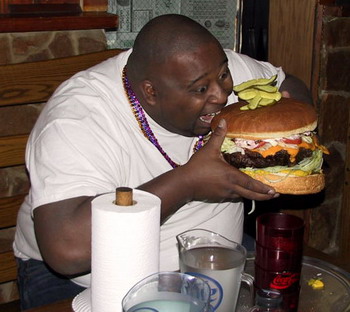
The burger war is growing. Literally. Denny's Beer Barrel Pub, which lost its crown as the home of the world's biggest burger earlier this year, is now offering a new burger that weighs a whopping 15 pounds.
Dubbed the Beer Barrel Belly Buster, the burger comes with 10.5 pounds of ground beef, 25 slices of cheese, a head of lettuce, three tomatoes, two onions, a cup-and-a-half each of mayonnaise, relish, ketchup, mustard and banana peppers — and a bun. It costs $30.
“It can feed a family of 10,” said Denny Liegey Sr., the restaurant's owner.
Denny's Beer Barrel Pub had offered a 6-pound burger — with 5 pounds of toppings. In February, a 100-pound female college student became the first to eat the burger within the three-hour time limit. Kate Stelnick, of Princeton, N.J., was awarded a special certificate, a T-shirt and other prizes and Leigey picked up the $23.95 tab for the burger.
One month later, the Clinton Station Diner in Clinton, N.J., introduced a 12.5-pound burger dubbed Zeus. So Liegey responded, and the Belly Buster was born. Over the weekend, four men took the challenge, but couldn't get through the entire burger. They opted for doggie bags, instead.
“It's a little too much for me to handle,” said Steve Hepburn, of Clearfield. “It's like trying to eat half a cow.”
Original link: http://www.thecourierexpress.com