Skip to content
The beaver is a proud and noble animal

The beaver is a proud and noble animal

Notes from a bemused canuck

  • Home
  • About
  • Bookmarks
  • Pictures
  • Resume
  • Wine
  • Random Recipe
  • Toggle search form

Tag: fiction

Aliens talking with and about humans

Posted on November 22, 2018November 25, 2018 By admin

Alien: “I’m sorry, what did you just say your comfortable temperature range is?”
Human: “Honestly we can tolerate anywhere from -40 to 50 Celcius, but we prefer the 0 to 30 range.”
Alien: “… I’m sorry, did you just list temperatures below freezing?”
Human: “Yeah, but most of us prefer to throw on scarves or jackets at those temperatures it can be a bit nippy.”
Other human: “Nah mate, I knew this guy in college who refused to wear anything past his knees and elbows until it was -20 at least.”
Human: “Heh. Yeah everybody knows someone like that.”
Alien: “… And did you also say 50 Celcius? As in, half way to boiling?”
Human: “Eugh. Yes. It sucks, we sweat everywhere, and god help you if you touch a seatbelt buckle, but yes.”
Alien: “And you say the poles of your world would get as low as negative one hundred with wind chill?”
Human: “Yup, with blizzards you cant see through every other day just about.”
Alien: “Amazing! when did you manage to send drones that could survive such temperatures?”
Human: “… well, actually… ”
Alien: “… what?”
Human: “… we kinda… sent… people. ”
Alien: “…”
Human: “…”
Alien: “what?”
Human: “we sent-”
Alien: “no yeah I heard you I just- what? You sent… HUMANS… to a place one hundred degrees below freezing?”
Human: “y-yeah”
Alien: “and they didn’t… die?”
Human: “Well the first few did”
Alien: “PEOPLE DIED OF THE COLD AND YOUR SOLUTION WAS TO SEND More PEOPLE???!?!?!?”


Alien: “You’re telling me that you have… settlements. On islands with active volcanism?”
Human: “Well, yeah. I’m not about to tell Iceland and Hawaii how to live their lives. Actually, it’s kind of a tourist attraction.”
Alien: “What, the molten rock?”
Human: “Well, yeah! It’s not every day you see a mountain spew out liquid rocks! The best one is Yellowstone, though. All these hot springs and geysers from the supervolcano–”
Alien: “You ACTIVELY SEEK OUT ACTIVE SUPERVOLCANOES?”
Human: “S**t, man, we swim in the groundwater near them.”


“Commander, we must update the code of conduct to include the humans.”

“Why? Are they more aggressive than we anticipated?”

“It seems to be the opposite Commander. Just this morning a crewman nearly lost their hand when attempting to stroke an unidentified feline on an unknown world. Their reaction to the attack was to call the creature a “mean kitty” and vow to win it over. Upon inquiry, it seems they bond so readily with creatures outside their species that they have the capacity to feel sympathy for an alien creature they have never seen before simply because it appears distressed. I hate to say this commander but we must install a rule to prevent them from endangering their own lives when interacting with the galaxy’s fauna.”

“I see what you mean. So be it, from now on no crewman is allowed to touch unknown animals without permission from a superior officer. And send a message to supplies about acquiring one of these “puppies” so that their desire to touch furred predators can be safely sated.


“So I hear that you’ve just recruited a human for your ship.”

“Yes, it’s the first time that I’ve worked with these species, but they come highly recommended. Say, you’ve worked with a few, what tips can you give me? I’d hate to have some kind of cultural misunderstanding if it’s avoidable.”

“The first rule of working with humans is to never leave them unsupervised.”

“Wait, what?”

“I’m serious. Don’t do it. Things. Happen.”

“But wait, I thought that I heard you highly recommended that every crew should have at least one on board?”

“Absolutely, and I stand by that. Humans are excellent innovators and are psychologically very resilient. If you have a crisis, then a human that has bonded with your crew properly can be invaluable. Treat your human well and you should get the best out of them as a crew member. Their ability to get on with almost any species is legendary.”

“But, didn’t you just say… ”

“The trouble is that they will potentially try to bond with anything. If you leave them unsupervised, you have no idea what kind of trouble they can get themselves into. It was sheer luck that the Fanzorians thought that it was funny that the human picked up the Crown Prince to coo at him.”

“Crown Prince Horram, Scourge of Pixia?”

“The very same. Surprisingly good sense of humor. But don’t even get me started on that one time with the Dunlip. Al-Human wanted to know if they could keep it. As a pet.”

“A Dunlip? You mean the 3-metre tall apex predators from Jowun?”

“Yup. Don’t leave your humans unsupervised.”

“I’ll uh, take that under advisement.”


“Seriously. Get a supply of safe animals for the humans to bond with or they will make their own. I mean, they will try to befriend anything they come across anyway, but without any permanent pets they can get… creative. Don’t even get me started on the time one of them taped a knife to one of our auto-cleaners and named it Stabby.

Three weeks in and when we finally caught the wretched thing, half the humans on crew tried to revolt about us “killing” Stabby by removing the knife.

“How… how did you resolve that sir?”

“Glaxcol made a toy knife out of insulation rubber and strapped that on instead. Quite a creative solution, I suppose.”

“And that sated the humans?

“Worse.”

“Worse?”

“They thought it was so funny they made a second one, strapped false eyes on springs to both and held mock battles. Then decided Stabby and Knifey were in love and now none of them will allow the others to stage fights between them any more.”

“So, if I supply my Humans with safe bonding pets they will behave better when on other planets? Where do I get safe bonding pets?”

“Realizing the havoc their species created with their bonding needs, Earth has been kind enough to create an intergalactic ‘pet’ shop as they call it, the order forms are on the bridge.”

“If they get a pet this should prevent any knife welding auto-cleaners?”

“Yes… ”

“You don’t sound very reassuring.”

“Well… You have to understand that some of what humans find attractive about their ‘pets’ is actually what makes them dangerous. Not all of what they consider ‘safe’ is what we would consider ‘safe’.”

“OK… I am getting a little nervous about this.”

“No, no, it’s fine, I’m just saying you should maybe keep an eye on what they order. Ask them to describe the creature before they get it. For example, the first time I had a human on board I let them order a pet without checking what it was.”

“What happened?”

Well, when it arrived it was a 25 pound fanged and clawed feline creature called a Savannah Cat. My entire crew was terrified of it, it was agile and could easily have seriously injured someone, but the human had no fear of it. They insisted on carrying it around like a child, and they would squeeze it’s ‘beans’ as they said, forcing the creatures claws out, and then they would show people it’s deadly claws while saying, and I quote, ‘look at its adorable claws, this is what it uses to kills things, isn’t it cute?’“

“Seriously?”

“I have also heard stories from other crews that their humans ordered canines that weigh as much or more then they do, and they sleep next to the giant creature.”

“You are not making me feel better with these stories.”
uncategorized

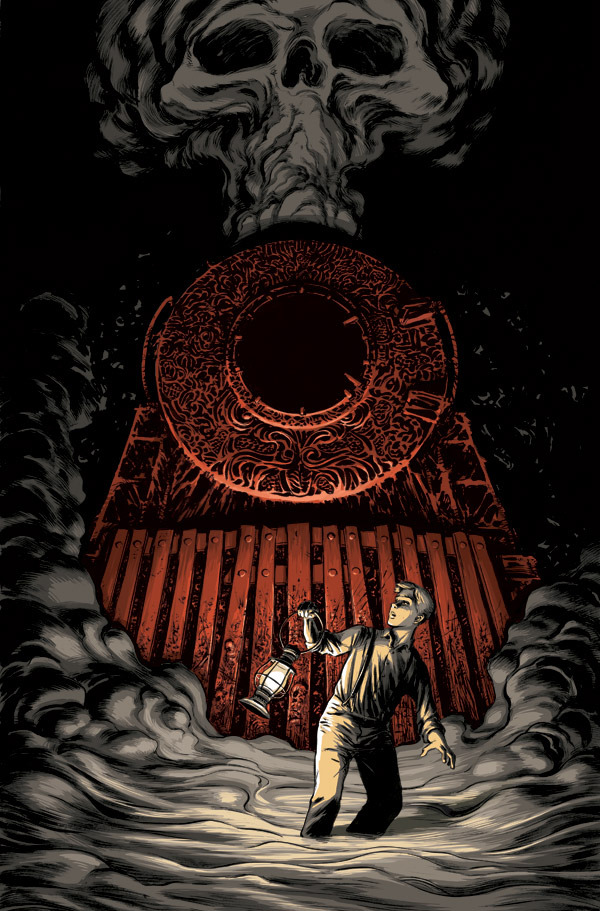
That Hell-Bound Train

Posted on March 10, 2014March 10, 2014 By admin

hellbound-train

That Hell-Bound Train
by Robert Bloch

When Martin was a little boy, his daddy was a Railroad Man. Daddy never rode the high iron, but he walked the tracks for the CB&Q, and he was proud of his job. And every night when he got drunk, he sang this old song about That Hell-Bound Train.

Martin didn’t quite remember any of the words, but he couldn’t forget the way his Daddy sang them out. And when Daddy made the mistake of getting drunk in the afternoon and got squeezed between a Pennsy tank-car and an AT&SF gondola, Martin sort of wondered why the Brotherhood didn’t sing the song at his funeral.

After that, things didn’t go so good for Martin, but somehow he always recalled Daddy’s song. When Mom up and ran off with a traveling salesman from Keokuk (Daddy must have turned over in his grave, knowing she’d done such a thing, and with a passenger, too!) Martin hummed the tune to himself every night in the Orphan Home. And after Martin himself ran away, he used to whistle the song softly at night in the jungles, after the other bindlestiffs were asleep.

Martin was on the road for four-five years before he realized he wasn’t getting anyplace. Of course he’d tried his hand at a lot of things — picking fruit in Oregon, washing dishes in a Montana hash-house, stealing hubcaps in Denver and tires in Oklahoma City — but by the time he’d put in six months on the chain gang down in Alabama he knew he had no future drifting around this way on his own.

So he tried to get on the railroad like his daddy had and they told him that times were bad. But Martin couldn’t keep away from the railroads. Wherever he traveled, he rode the rods; he’d rather hop a freight heading north in sub-zero weather than lift his thumb to hitch a ride with a Cadillac headed for Florida. Whenever he managed to get hold of a can of Sterno, he’d sit there under a nice warm culvert, think about the old days, and often as not he’d hum the song about That Hell-Bound Train. That was the train the drunks and the sinners rode — the gambling men and the grifters, the big-time spenders, the skirt-chasers, and all the jolly crew. It would be really fine to take a trip in such good company, but Martin didn’t like to think of what happened when that train finally pulled into the Depot Way Down Yonder. He didn’t figure on spending eternity stoking boilers in Hell, without even a Company Union to protect him. Still, it would be a lovely ride. If there was such a thing as a Hell-Bound Train. Which, of course, there wasn’t.

At least Martin didn’t think there was, until that evening when he found himself walking the tracks heading south, just outside of Appleton Junction. The night was cold and dark, the way November nights are in the Fox River Valley, and he knew he’d have to work his way down to New Orleans for the winter, or maybe even Texas. Somehow he didn’t much feel like going, even though he’d heard tell that a lot of those Texas automobiles had solid gold hub-caps.

No sir, he just wasn’t cut out for petty larceny. It was worse than a sin — it was unprofitable, too. Bad enough to do the Devil’s work, but then to get such miserable pay on top of it! Maybe he’d better let the Salvation Army convert him.

Martin trudged along humming Daddy’s song, waiting for a rattler to pull out of the Junction behind him. He’d have to catch it — there was nothing else for him to do.

But the first train to come along came from the other direction, roaring toward him along the track from the south.

Martin peered ahead, but his eyes couldn’t match his ears, and so far all he could recognize was the sound. It was a train, though; he felt the steel shudder and sing beneath his feet.

And yet, how could it be? The next station south was Neenah-Menasha, and there was nothing due out of there for hours.

The clouds were thick overhead, and the field mists rolled like a cold fog in a November midnight. Even so, Martin should have been able to see the headlight as the train rushed on. But there was only the whistle, screaming out of the black throat of the night. Martin could recognize the equipment of just about any locomotive ever built, but he’d never heard a whistle that sounded like this one. It wasn’t signaling; it was screaming like a lost soul.

He stepped to one side, for the train was almost on top of him now. And suddenly there it was, looming along the tracks and grinding to a stop in less time than he’d believed possible. The wheels hadn’t been oiled, because they screamed too, screamed like the damned. But the train slid to a halt and the screams died away into a series of low, groaning sounds, and Martin looked up and saw that this was a passenger train. It was big and black, without a single light shining in the engine cab or any of the long string of cars; Martin couldn’t read any lettering on the sides, but he was pretty sure this train didn’t belong on the Northwestern Road.

He was even more sure when he saw the man clamber down out of the forward car. There was something wrong about the way he walked, as though one of his feet dragged, and about the lantern he carried. The lantern was dark, and the man held it up to his mouth and blew, and instantly it glowed redly. You don’t have to be a member of the Railway Brotherhood to know that this is a mighty peculiar way of lighting a lantern.

As the figure approached, Martin recognized the conductor’s cap perched on his head, and this made him feel a little better for a moment — until he noticed that it was worn a bit too high, as though there might be something sticking up on the forehead underneath it.

Still, Martin knew his manners, and when the man smiled at him, he said, “Good evening, Mr. Conductor.”

“Good evening, Martin.”

“How did you know my name?”

The man shrugged. “How did you know I was the Conductor?”

“You are, aren’t you?”

“To you, yes. Although other people, in other walks of life, may recognize me in different roles. For instance, you ought to see what I look like to the folks out in Hollywood.” The man grinned. “I travel a great deal,” he explained.

“What brings you here?” Martin asked.

“Why, you ought to know the answer to that, Martin. I came because you needed me. Tonight, I suddenly realized you were backsliding. Thinking of joining the Salvation Army, weren’t you?”

“Well — ” Martin hesitated.

“Don’t be ashamed. To err is human, as somebody-or-other-once said. Reader’s Digest, wasn’t it? Never mind. The point is, I felt you needed me. So I switched over and came your way.”

“What for?”

“Why, to offer you a ride, of course. Isn’t it better to travel comfortably by train than to march along the cold streets behind a Salvation Army band? Hard on the feet, they tell me, and even harder on the eardrums.”

“I’m not sure I’d care to ride your train, sir,” Martin said. “Considering where I’m likely to end up.”

“Ah, yes. The old argument.” The Conductor sighed. “I suppose you’d prefer some sort of bargain, is that it?”

“Exactly,” Martin answered.

“Well, I’m afraid I’m all through with that sort of thing. There’s no shortage of prospective passengers anymore. Why should I offer you any special inducements?”

“You must want me, or else you wouldn’t have bothered to go out of your way to find me.”

The Conductor sighed again. “There you have a point. Pride was always my besetting weakness, I admit. And somehow I’d hate to lose you to the competition, after thinking of you as my own all these years.” He hesitated. “Yes, I’m prepared to deal with you on your own terms, if you insist.”

“The terms?” Martin asked.

“Standard proposition. Anything you want.”

“Ah,” said Martin.

“But I warn you in advance, there’ll be no tricks. I’ll grant you any wish you can name — but in return, you must promise to ride the train when the time comes.”

“Suppose it never comes?”

“It will.”

“Suppose I’ve got the kind of a wish that will keep me off forever?”

“There is no such wish.”

“Don’t be too sure.”

“Let me worry about that,” the Conductor told him. “No matter what you have in mind, I warn you that I’ll collect in the end. And there’ll be none of this last-minute hocus-pocus, either. No last-hour repentances, no blonde frauleins or fancy lawyers showing up to get you off. I offer a clean deal. That is to say, you’ll get what you want, and I’ll get what I want.”

“I’ve heard you trick people. They say you’re worse than a used-car salesman.”

“Now, wait a minute — ”

“I apologize,” Martin said, hastily. “But it is supposed to be a fact that you can’t be trusted.”

“I admit it. On the other hand, you seem to think you have found a way out.”

“A sure-fire proposition.”

“Sure-fire? Very funny!” The man began to chuckle, then halted. “But we waste valuable time, Martin. Let’s get down to cases. What do you want from me?”

Martin took a deep breath. “I want to be able to stop Time.”

“Right now?”

“No. Not yet. And not for everybody. I realize that would be impossible, of course. But I want to be able to stop Time for myself. Just once, in the future. Whenever I get to a point where I know I’m happy and contented, that’s where I’d like to stop. So I can just keep on being happy forever.”

“That’s quite a proposition,” the Conductor mused. “I’ve got to admit I’ve never heard anything just like it before — and believe me, I’ve listened to some lulus in my day.” He grinned at Martin. “You’ve really been thinking about this, haven’t you?”

“For years,” Martin admitted. Then he coughed. “Well, what do you say?”

“It’s not impossible, in terms of your own subjective time-sense,” the Conductor murmured. “Yes, I think it could be arranged.”

“But I mean really to stop. Not for me just to imagine it.”

“I understand. And it can be done.”

“Then you’ll agree?”

“Why not? I promised you, didn’t I? Give me your hand.”

Martin hesitated. “Will it hurt very much? I mean, I don’t like the sight of blood, and — ”

“Nonsense! You’ve been listening to a lot of poppycock. We already have made our bargain, my boy. I merely intend to put something into your hand. The ways and means of fulfilling your wish. After all, there’s no telling at just what moment you may decide to exercise the agreement, and I can’t drop everything and come running. So it’s better if you can regulate matters for yourself.”

“You’re going to give me a Time-stopper?”

“That’s the general idea. As soon as I can decide what would be practical.” The Conductor hesitated. “Ah, the very thing! Here, take my watch.”

He pulled it out of his vest-pocket; a railroad watch in a silver case. He opened the back and made a delicate adjustment; Martin tried to see just exactly what he was doing, but the fingers moved in a blinding blur.

“There we are.” The Conductor smiled. “It’s all set, now. When you finally decide where you’d like to call a halt, merely turn the stem in reverse and unwind the watch until it stops. When it stops, Time stops, for you. Simple enough?” And the Conductor dropped the watch into Martin’s hand.

The young man closed his fingers tightly around the case. “That’s all there is to it, eh?”

“Absolutely. But remember — you can stop the watch only once. So you’d better make sure that you’re satisfied with the moment you choose to prolong. I caution you in all fairness; make very certain of your choice.”

“I will.” Martin grinned. “And since you’ve been so fair about it, I’ll be fair, too. There’s one thing you seem to have forgotten. It doesn’t really matter what moment I choose. Because once I stop Time for myself, that means I stay where I am forever. I’ll never have to get any older. And if I don’t get any older, I’ll never die. And if I never die, then I’ll never have to take a ride on your train.”

The Conductor turned away. His shoulders shook convulsively, and he may have been crying. “And you said I was worse than a used-car salesman,” he gasped, in a strangled voice.

Then he wandered off into the fog, and the train-whistle gave an impatient shriek, and all at once it was moving swiftly down the track, rumbling out of sight in the darkness.

Martin stood there, blinking down at the silver watch in his hand. If it wasn’t that he could actually see it and feel it there, and if he couldn’t smell that peculiar odor, he might have thought he’d imagined the whole thing from start to finish — train, Conductor, bargain, and all.

But he had the watch, and he could recognize the scent left by the train as it departed, even though there aren’t many locomotives around that use sulphur and brimstone as fuel.

And he had no doubts about his bargain. That’s what came of thinking things through to a logical conclusion. Some fools would have settled for wealth, or power, or Kim Novak. Daddy might have sold out for a fifth of whiskey.

Martin knew that he’d made a better deal. Better? It was foolproof. All he needed to do now was choose his moment.

He put the watch in his pocket and started back down the railroad track. He hadn’t really had a destination in mind before, but he did now. He was going to find a moment of happiness…

——————————————————————————–

Now young Martin wasn’t altogether a ninny. He realized perfectly well that happiness is a relative thing; there are conditions and degrees of contentment, and they vary with one’s lot in life. As a hobo, he was often satisfied with a warm handout, a double-length bench in the park, or a can of Sterno made in 1957 (a vintage year). Many a time he had reached a state of momentary bliss through such simple agencies, but he was aware that there were better things. Martin determined to seek them out.

Within two days he was in the great city of Chicago. Quite naturally, he drifted over to West Madison Street, and there he took steps to elevate his role in life. He became a city bum, a panhandler, a moocher. Within a week he had risen to the point where happiness was a meal in a regular one-arm luncheon joint, a two-bit flop on a real army cot in a real flophouse, and a full fifth of muscatel.

There was a night, after enjoying all three of these luxuries to the full, when Martin thought of unwinding his watch at the pinnacle of intoxication. But he also thought of the faces of the honest johns he’d braced for a handout today. Sure, they were squares, but they were prosperous. They wore good clothes, held good jobs, drove nice cars. And for them, happiness was even more ecstatic — they ate dinner in fine hotels, they slept on innerspring mattresses, they drank blended whiskey.

Squares or no, they had something there. Martin fingered his watch, put aside the temptation to hock it for another bottle of muscatel, and went to sleep determined to get himself a job and improve his happiness-quotient.

When he awoke he had a hangover, but the determination was still with him. Before the month was out Martin was working for a general contractor over on the South Side, at one of the big rehabilitation projects. He hated the grind, but the pay was good, and pretty soon he got himself a one-room apartment out on Blue Island Avenue. He was accustomed to eating in decent restaurants now, and he bought himself a comfortable bed, and every Saturday night he went down to the corner tavern. It was all very pleasant, but —

The foreman liked his work and promised him a raise in a month. If he waited around, the raise would mean that he could afford a second-hand car. With a car, he could even start picking up a girl for a date now and then. Other fellows on the job did, and they seemed pretty happy.

So Martin kept on working, and the raise came through and the car came through and pretty soon a couple of girls came through.

The first time it happened, he wanted to unwind his watch immediately. Until he got to thinking about what some of the older men always said. There was a guy named Charlie, for example, who worked alongside him on the hoist. “When you’re young and don’t know the score, maybe you get a kick out of running around with those pigs. But after a while, you want something better. A nice girl of your own. That’s the ticket.”

Martin felt he owed it to himself to find out. If he didn’t like it better, he could always go back to what he had.

Almost six months went by before Martin met Lillian Gillis. By that time he’d had another promotion and was working inside, in the office. They made him go to night school to learn how to do simple bookkeeping, but it meant another fifteen bucks extra a week, and it was nicer working indoors.

And Lillian was a lot of fun. When she told him she’d marry him, Martin was almost sure that the time was now. Except that she was sort of — well, she was a nice girl, and she said they’d have to wait until they were married. Of course, Martin couldn’t expect to marry her until he had a little more money saved up, and another raise would help, too.

That took a year. Martin was patient, because he knew it was going to be worth it. Every time he had any doubts, he took out his watch and looked at it. But he never showed it to Lillian, or anybody else. Most of the other men wore expensive wristwatches and the old silver railroad watch looked just a little cheap.

Martin smiled as he gazed at the stem. Just a few twists and he’d have something none of these other poor working slobs would ever have. Permanent satisfaction, with his blushing bride — Only getting married turned out to be just the beginning. Sure, it was wonderful, but Lillian told him how much better things would be if they could move into a new place and fix it up. Martin wanted decent furniture, a TV set, a nice car.

So he started taking night courses and got a promotion to the front office. With the baby coming, he wanted to stick around and see his son arrive. And when it came, he realized he’d have to wait until it got a little older, started to walk and talk and develop a personality of its own.

About this time the company sent him out on the road as a trouble-shooter on some of those other jobs, and now he was eating at those good hotels, living high on the hog and the expense-account. More than once he was tempted to unwind his watch. This was the good life… Of course, it would be even better if he just didn’t have to work. Sooner or later, if he could cut in on one of the company deals, he could make a pile and retire. Then everything would be ideal. It happened, but it took time. Martin’s son was going to high school before he really got up there into the chips. Martin got a strong hunch that it was now or never, because he wasn’t exactly a kid anymore.

But right about then he met Sherry Westcott, and she didn’t seem to think he was middle-aged at all, in spite of the way he was losing hair and adding stomach. She taught him that a toupee could cover the bald spot and a cummerbund could cover the pot-gut. In fact, she taught him quite a lot and he so enjoyed learning that he actually took out his watch and prepared to unwind it.

Unfortunately, he chose the very moment that the private detectives broke down the door of the hotel room, and then there was a long stretch of time when Martin was so busy fighting the divorce action that he couldn’t honestly say he was enjoying any given moment.

When he made the final settlement with Lil he was broke again, and Sherry didn’t seem to think he was so young, after all. So he squared his shoulders and went back to work.

He made his pile, eventually, but it took longer this time, and there wasn’t much chance to have fun along the way. The fancy dames in the fancy cocktail lounges didn’t seem to interest him anymore, and neither did the liquor. Besides, the Doc had warned him off that.

But there were other pleasures for a rich man to investigate. Travel, for instance — and not riding the rods from one hick burg to another, either. Martin went around the world by plane and luxury liner. For a while it seemed as though he would find his moment after all, visiting the Taj Mahal by moonlight. Martin pulled out the battered old watch-case, and got ready to unwind it. Nobody else was there to watch him —

And that’s why he hesitated. Sure, this was an enjoyable moment, but he was alone. Lil and the kid were gone, Sherry was gone, and somehow he’d never had time to make any friends. Maybe if he found new congenial people, he’d have the ultimate happiness. That must be the answer — it wasn’t just money or power or sex or seeing beautiful things. The real satisfaction lay in friendship.

So on the boat trip home, Martin tried to strike up a few acquaintances at the ship’s bar. But all these people were much younger, and Martin had nothing in common with them. Also they wanted to dance and drink, and Martin wasn’t in condition to appreciate such pastimes. Nevertheless, he tried.

Perhaps that’s why he had the little accident the day before they docked in San Francisco. “Little accident” was the ship’s doctor’s way of describing it, but Martin noticed he looked very grave when he told him to stay in bed, and he’d called an ambulance to meet the liner at the dock and take the patient right to the hospital.

At the hospital, all the expensive treatment and the expensive smiles and the expensive words didn’t fool Martin any. He was an old man with a bad heart, and they thought he was going to die.

But he could fool them. He still had the watch. He found it in his coat when he put on his clothes and sneaked out of the hospital.

He didn’t have to die. He could cheat death with a single gesture — and he intended to do it as a free man, out there under a free sky.

That was the real secret of happiness. He understood it now. Not even friendship meant as much as freedom. This was the best thing of all — to be free of friends or family or the furies of the flesh.

Martin walked slowly beside the embankment under the night sky. Come to think of it, he was just about back where he’d started, so many years ago. But the moment was good, good enough to prolong forever. Once a bum, always a bum.

He smiled as he thought about it, and then the smile twisted sharply and suddenly, like the pain twisting sharply and suddenly in his chest. The world began to spin and he fell down on the side of the embankment.

He couldn’t see very well, but he was still conscious, and he knew what had happened. Another stroke, and a bad one. Maybe this was it. Except that he wouldn’t be a fool any longer. He wouldn’t wait to see what was still around the corner.

Right now was his chance to use his power and save his life. And he was going to do it. He could still move, nothing could stop him. He groped in his pocket and pulled out the old silver watch, fumbling with the stem. A few twists and he’d cheat death, he’d never have to ride that Hell-Bound Train. He could go on forever. Forever.

Martin had never really considered the word before. To go on forever — but how? Did he want to go on forever, like this; a sick old man, lying helplessly here in the grass?

No. He couldn’t do it. He wouldn’t do it. And suddenly he wanted very much to cry, because he knew that somewhere along the line he’d outsmarted himself. And now it was too late. His eyes dimmed, there was a roaring in his ears…

He recognized the roaring, of course, and he wasn’t at all surprised to see the train come rushing out of the fog up there on the embankment. He wasn’t surprised when it stopped, either, or when the Conductor climbed off and walked slowly toward him.

The Conductor hadn’t changed a bit. Even his grin was still the same.

“Hello, Martin,” he said. “All aboard.”

“I know,” Martin whispered. “But you’ll have to carry me. I can’t walk. I’m not even really talking anymore, am I?”

“Yes you are,” the Conductor said. “I can hear you fine. And you can walk, too.” He leaned down and placed his hand on Martin’s chest. There was a moment of icy numbness, and then, sure enough, Martin could walk after all.

He got up and followed the Conductor along the slope, moving to the side of the train.

“In here?” he asked.

“No, the next car,” the Conductor murmured. “I guess you’re entitled to ride Pullman. After all, you’re quite a successful man. You’ve tasted the joys of wealth and position and prestige. You’ve known the pleasures of marriage and fatherhood. You’ve sampled the delights of dining and drinking and debauchery, too, and you traveled high, wide, and handsome. So let’s not have any last-minute recriminations.”

“All right,” Martin sighed. “I can’t blame you for my mistakes. On the other hand, you can’t take credit for what happened, either. I worked for everything I got. I did it all on my own. I didn’t even need your watch.”

“So you didn’t,” the Conductor said, smiling. “But would you mind giving it back to me now?”

“Need it for the next sucker, eh?” Martin muttered.

“Perhaps.”

Something about the way he said it made Martin look up. He tried to see the Conductor’s eyes, but the brim of his cap cast a shadow. So Martin looked down at the watch instead.

“Tell me something,” he said, softly. “If I give you the watch, what will you do with it?”

“Why, throw it into the ditch,” the Conductor told him. “That’s all I’ll do with it.” And he held out his hand.

“What if somebody comes along and finds it? And twists the stem backward, and stops Time?”

“Nobody would do that,” the Conductor murmured. “Even if they knew.”

“You mean, it was all a trick? This is only an ordinary, cheap watch?”

“I didn’t say that,” whispered the Conductor. “I only said that no one has ever twisted the stem backward. They’ve all been like you, Martin — looking ahead to find that perfect happiness. Waiting for the moment that never comes.”

The Conductor held out his hand again.

Martin sighed and shook his head. “You cheated me after all.”

“You cheated yourself, Martin. And now you’re going to ride that Hell-Bound Train.”

He pushed Martin up the steps and into the car ahead. As he entered, the train began to move and the whistle screamed. And Martin stood there in the swaying Pullman, gazing down the aisle at the other passengers. He could see them sitting there, and somehow it didn’t seem strange at all.

Here they were; the drunks and the sinners, the gambling men and the grifters, the big-time spenders, the skirt-chasers, and all the jolly crew. They knew where they were going, of course, but they didn’t seem to give a damn. The blinds were drawn on the windows, yet it was light inside, and they were all living it up — singing and passing the bottle and roaring with laughter, throwing the dice and telling their jokes and bragging their big brags, just the way Daddy used to sing about them in the old song.

“Mighty nice traveling companions,” Martin said. “Why, I’ve never seen such a pleasant bunch of people. I mean, they seem to be really enjoying themselves!”

The Conductor shrugged. “I’m afraid things won’t be quite so jazzy when we pull into that Depot Way Down Yonder.”

For the third time, he held out his hand. “Now, before you sit down, if you’ll just give me that watch. A bargain’s a bargain—”

Martin smiled. “A bargain’s a bargain,” he echoed. “I agreed to ride your train if I could stop Time when I found the right moment of happiness. And I think I’m about as happy right here as I’ve ever been.”

Very slowly, Martin took hold of the silver watch-stem.

“No!” gasped the Conductor. “No!”

But the watch-stem turned.

“Do you realize what you’ve done?” the Conductor yelled. “Now we’ll never reach the Depot! We’ll just go on riding, all of us — forever!”

Martin grinned. “I know,” he said. “But the fun is in the trip, not the destination. You taught me that. And I’m looking forward to a wonderful trip. Look, maybe I can even help. If you were to find me another one of those caps, now, and let me keep this watch—”

And that’s the way it finally worked out. Wearing his cap and carrying his battered old silver watch, there’s no happier person in or out of this world — now and forever — than Martin. Martin, the new Brakeman on That Hellhound Train.

uncategorized

Paper Menagerie

Posted on November 13, 2012 By admin

Yoinked from Io9: http://io9.com/5958919/read-ken-lius-amazing-story-that-swept-the-hugo-nebula-and-world-fantasy-awards

Ken Liu’s incredible story “Paper Menagerie” just became the first work of fiction to win all three of SF’s major awards: the Hugo, the Nebula and the World Fantasy Award. And we’re proud to be able to reprint the whole story, right here at io9. Here’s your chance to find out what all the excitement is about, and discover one of science fiction’s fastest rising stars.

“Paper Menagerie”
by Ken Liu

One of my earliest memories starts with me sobbing. I refused to be soothed no matter what Mom and Dad tried.

Dad gave up and left the bedroom, but Mom took me into the kitchen and sat me down at the breakfast table.

“Kan, kan,” she said, as she pulled a sheet of wrapping paper from on top of the fridge. For years, Mom carefully sliced open the wrappings around Christmas gifts and saved them on top of the fridge in a thick stack.

She set the paper down, plain side facing up, and began to fold it. I stopped crying and watched her, curious.

She turned the paper over and folded it again. She pleated, packed, tucked, rolled, and twisted until the paper disappeared between her cupped hands. Then she lifted the folded-up paper packet to her mouth and blew into it, like a balloon.

“Kan,” she said. “Laohu.” She put her hands down on the table and let go.

A little paper tiger stood on the table, the size of two fists placed together. The skin of the tiger was the pattern on the wrapping paper, white background with red candy canes and green Christmas trees.

I reached out to Mom’s creation. Its tail twitched, and it pounced playfully at my finger. “Rawrr-sa,” it growled, the sound somewhere between a cat and rustling newspapers.

I laughed, startled, and stroked its back with an index finger. The paper tiger vibrated under my finger, purring.

“Zhe jiao zhezhi,” Mom said. This is called origami.

I didn’t know this at the time, but Mom’s kind was special. She breathed into them so that they shared her breath, and thus moved with her life. This was her magic.

#

Dad had picked Mom out of a catalog.

One time, when I was in high school, I asked Dad about the details. He was trying to get me to speak to Mom again.

He had signed up for the introduction service back in the spring of 1973. Flipping through the pages steadily, he had spent no more than a few seconds on each page until he saw the picture of Mom.

I’ve never seen this picture. Dad described it: Mom was sitting in a chair, her side to the camera, wearing a tight green silk cheongsam. Her head was turned to the camera so that her long black hair was draped artfully over her chest and shoulder. She looked out at him with the eyes of a calm child.

“That was the last page of the catalog I saw,” he said.

The catalog said she was eighteen, loved to dance, and spoke good English because she was from Hong Kong. None of these facts turned out to be true.

He wrote to her, and the company passed their messages back and forth. Finally, he flew to Hong Kong to meet her.

“The people at the company had been writing her responses. She didn’t know any English other than ‘hello’ and ‘goodbye.'”

What kind of woman puts herself into a catalog so that she can be bought? The high school me thought I knew so much about everything. Contempt felt good, like wine.

Instead of storming into the office to demand his money back, he paid a waitress at the hotel restaurant to translate for them.

“She would look at me, her eyes halfway between scared and hopeful, while I spoke. And when the girl began translating what I said, she’d start to smile slowly.”

He flew back to Connecticut and began to apply for the papers for her to come to him. I was born a year later, in the Year of the Tiger.

#

At my request, Mom also made a goat, a deer, and a water buffalo out of wrapping paper. They would run around the living room while Laohu chased after them, growling. When he caught them he would press down until the air went out of them and they became just flat, folded-up pieces of paper. I would then have to blow into them to re-inflate them so they could run around some more.

Sometimes, the animals got into trouble. Once, the water buffalo jumped into a dish of soy sauce on the table at dinner. (He wanted to wallow, like a real water buffalo.) I picked him out quickly but the capillary action had already pulled the dark liquid high up into his legs. The sauce-softened legs would not hold him up, and he collapsed onto the table. I dried him out in the sun, but his legs became crooked after that, and he ran around with a limp. Mom eventually wrapped his legs in saran wrap so that he could wallow to his heart’s content (just not in soy sauce).

Also, Laohu liked to pounce at sparrows when he and I played in the backyard. But one time, a cornered bird struck back in desperation and tore his ear. He whimpered and winced as I held him and Mom patched his ear together with tape. He avoided birds after that.

And then one day, I saw a TV documentary about sharks and asked Mom for one of my own. She made the shark, but he flapped about on the table unhappily. I filled the sink with water, and put him in. He swam around and around happily. However, after a while he became soggy and translucent, and slowly sank to the bottom, the folds coming undone. I reached in to rescue him, and all I ended up with was a wet piece of paper.

Laohu put his front paws together at the edge of the sink and rested his head on them. Ears drooping, he made a low growl in his throat that made me feel guilty.

Mom made a new shark for me, this time out of tin foil. The shark lived happily in a large goldfish bowl. Laohu and I liked to sit next to the bowl to watch the tin foil shark chasing the goldfish, Laohu sticking his face up against the bowl on the other side so that I saw his eyes, magnified to the size of coffee cups, staring at me from across the bowl.

#

When I was ten, we moved to a new house across town. Two of the women neighbors came by to welcome us. Dad served them drinks and then apologized for having to run off to the utility company to straighten out the prior owner’s bills. “Make yourselves at home. My wife doesn’t speak much English, so don’t think she’s being rude for not talking to you.”

While I read in the dining room, Mom unpacked in the kitchen. The neighbors conversed in the living room, not trying to be particularly quiet.

“He seems like a normal enough man. Why did he do that?”

“Something about the mixing never seems right. The child looks unfinished. Slanty eyes, white face. A little monster.”

“Do you think he can speak English?”

The women hushed. After a while they came into the dining room.

“Hello there! What’s your name?”

“Jack,” I said.

“That doesn’t sound very Chinesey.”

Mom came into the dining room then. She smiled at the women. The three of them stood in a triangle around me, smiling and nodding at each other, with nothing to say, until Dad came back.

#

Mark, one of the neighborhood boys, came over with his Star Wars action figures. Obi-Wan Kenobi’s lightsaber lit up and he could swing his arms and say, in a tinny voice, “Use the Force!” I didn’t think the figure looked much like the real Obi-Wan at all.

Together, we watched him repeat this performance five times on the coffee table. “Can he do anything else?” I asked.

Mark was annoyed by my question. “Look at all the details,” he said.

I looked at the details. I wasn’t sure what I was supposed to say.

Mark was disappointed by my response. “Show me your toys.”

I didn’t have any toys except my paper menagerie. I brought Laohu out from my bedroom. By then he was very worn, patched all over with tape and glue, evidence of the years of repairs Mom and I had done on him. He was no longer as nimble and sure-footed as before. I sat him down on the coffee table. I could hear the skittering steps of the other animals behind in the hallway, timidly peeking into the living room.

“Xiao laohu,” I said, and stopped. I switched to English. “This is Tiger.” Cautiously, Laohu strode up and purred at Mark, sniffing his hands.

Mark examined the Christmas-wrap pattern of Laohu’s skin. “That doesn’t look like a tiger at all. Your Mom makes toys for you from trash?”

I had never thought of Laohu as trash. But looking at him now, he was really just a piece of wrapping paper.

Mark pushed Obi-Wan’s head again. The lightsaber flashed; he moved his arms up and down. “Use the Force!”

Laohu turned and pounced, knocking the plastic figure off the table. It hit the floor and broke, and Obi-Wan’s head rolled under the couch. “Rawwww,” Laohu laughed. I joined him.

Mark punched me, hard. “This was very expensive! You can’t even find it in the stores now. It probably cost more than what your dad paid for your mom!”

I stumbled and fell to the floor. Laohu growled and leapt at Mark’s face.

Mark screamed, more out of fear and surprise than pain. Laohu was only made of paper, after all.

Mark grabbed Laohu and his snarl was choked off as Mark crumpled him in his hand and tore him in half. He balled up the two pieces of paper and threw them at me. “Here’s your stupid cheap Chinese garbage.”

After Mark left, I spent a long time trying, without success, to tape together the pieces, smooth out the paper, and follow the creases to refold Laohu. Slowly, the other animals came into the living room and gathered around us, me and the torn wrapping paper that used to be Laohu.

#

My fight with Mark didn’t end there. Mark was popular at school. I never want to think again about the two weeks that followed.

I came home that Friday at the end of the two weeks. “Xuexiao hao ma?” Mom asked. I said nothing and went to the bathroom. I looked into the mirror. I look nothing like her, nothing.

At dinner I asked Dad, “Do I have a chink face?”

Dad put down his chopsticks. Even though I had never told him what happened in school, he seemed to understand. He closed his eyes and rubbed the bridge of his nose. “No, you don’t.”

Mom looked at Dad, not understanding. She looked back at me. “Sha jiao chink?”

“English,” I said. “Speak English.”

She tried. “What happen?”

I pushed the chopsticks and the bowl before me away: stir-fried green peppers with five-spice beef. “We should eat American food.”

Dad tried to reason. “A lot of families cook Chinese sometimes.”

“We are not other families.” I looked at him. Other families don’t have moms who don’t belong.

He looked away. And then he put a hand on Mom’s shoulder. “I’ll get you a cookbook.”

Mom turned to me. “Bu haochi?”

“English,” I said, raising my voice. “Speak English.”

Mom reached out to touch my forehead, feeling for my temperature. “Fashao la?”

I brushed her hand away. “I’m fine. Speak English!” I was shouting.

“Speak English to him,” Dad said to Mom. “You knew this was going to happen some day. What did you expect?”

Mom dropped her hands to her side. She sat, looking from Dad to me, and back to Dad again. She tried to speak, stopped, and tried again, and stopped again.

“You have to,” Dad said. “I’ve been too easy on you. Jack needs to fit in.”

Mom looked at him. “If I say ‘love,’ I feel here.” She pointed to her lips. “If I say ‘ai,’ I feel here.” She put her hand over her heart.

Dad shook his head. “You are in America.”

Mom hunched down in her seat, looking like the water buffalo when Laohu used to pounce on him and squeeze the air of life out of him.

“And I want some real toys.”

#

Dad bought me a full set of Star Wars action figures. I gave the Obi-Wan Kenobi to Mark.

I packed the paper menagerie in a large shoebox and put it under the bed.

The next morning, the animals had escaped and took over their old favorite spots in my room. I caught them all and put them back into the shoebox, taping the lid shut. But the animals made so much noise in the box that I finally shoved it into the corner of the attic as far away from my room as possible.

If Mom spoke to me in Chinese, I refused to answer her. After a while, she tried to use more English. But her accent and broken sentences embarrassed me. I tried to correct her. Eventually, she stopped speaking altogether if I were around.

Mom began to mime things if she needed to let me know something. She tried to hug me the way she saw American mothers did on TV. I thought her movements exaggerated, uncertain, ridiculous, graceless. She saw that I was annoyed, and stopped.

“You shouldn’t treat your mother that way,” Dad said. But he couldn’t look me in the eyes as he said it. Deep in his heart, he must have realized that it was a mistake to have tried to take a Chinese peasant girl and expect her to fit in the suburbs of Connecticut.

Mom learned to cook American style. I played video games and studied French.

Every once in a while, I would see her at the kitchen table studying the plain side of a sheet of wrapping paper. Later a new paper animal would appear on my nightstand and try to cuddle up to me. I caught them, squeezed them until the air went out of them, and then stuffed them away in the box in the attic.

Mom finally stopped making the animals when I was in high school. By then her English was much better, but I was already at that age when I wasn’t interested in what she had to say whatever language she used.

Sometimes, when I came home and saw her tiny body busily moving about in the kitchen, singing a song in Chinese to herself, it was hard for me to believe that she gave birth to me. We had nothing in common. She might as well be from the moon. I would hurry on to my room, where I could continue my all-American pursuit of happiness.

#

Dad and I stood, one on each side of Mom, lying on the hospital bed. She was not yet even forty, but she looked much older.

For years she had refused to go to the doctor for the pain inside her that she said was no big deal. By the time an ambulance finally carried her in, the cancer had spread far beyond the limits of surgery.

My mind was not in the room. It was the middle of the on-campus recruiting season, and I was focused on resumes, transcripts, and strategically constructed interview schedules. I schemed about how to lie to the corporate recruiters most effectively so that they’ll offer to buy me. I understood intellectually that it was terrible to think about this while your mother lay dying. But that understanding didn’t mean I could change how I felt.

She was conscious. Dad held her left hand with both of his own. He leaned down to kiss her forehead. He seemed weak and old in a way that startled me. I realized that I knew almost as little about Dad as I did about Mom.

Mom smiled at him. “I’m fine.”

She turned to me, still smiling. “I know you have to go back to school.” Her voice was very weak and it was difficult to hear her over the hum of the machines hooked up to her. “Go. Don’t worry about me. This is not a big deal. Just do well in school.”

I reached out to touch her hand, because I thought that was what I was supposed to do. I was relieved. I was already thinking about the flight back, and the bright California sunshine.

She whispered something to Dad. He nodded and left the room.

“Jack, if — ” she was caught up in a fit of coughing, and could not speak for some time. “If I don’t make it, don’t be too sad and hurt your health. Focus on your life. Just keep that box you have in the attic with you, and every year, at Qingming, just take it out and think about me. I’ll be with you always.”

Qingming was the Chinese Festival for the Dead. When I was very young, Mom used to write a letter on Qingming to her dead parents back in China, telling them the good news about the past year of her life in America. She would read the letter out loud to me, and if I made a comment about something, she would write it down in the letter too. Then she would fold the letter into a paper crane, and release it, facing west. We would then watch, as the crane flapped its crisp wings on its long journey west, towards the Pacific, towards China, towards the graves of Mom’s family.

It had been many years since I last did that with her.

“I don’t know anything about the Chinese calendar,” I said. “Just rest, Mom. ”

“Just keep the box with you and open it once in a while. Just open — ” she began to cough again.

“It’s okay, Mom.” I stroked her arm awkwardly.

“Haizi, mama ai ni — ” Her cough took over again. An image from years ago flashed into my memory: Mom saying ai and then putting her hand over her heart.

“Alright, Mom. Stop talking.”

Dad came back, and I said that I needed to get to the airport early because I didn’t want to miss my flight.

She died when my plane was somewhere over Nevada.

#

Dad aged rapidly after Mom died. The house was too big for him and had to be sold. My girlfriend Susan and I went to help him pack and clean the place.

Susan found the shoebox in the attic. The paper menagerie, hidden in the uninsulated darkness of the attic for so long, had become brittle and the bright wrapping paper patterns had faded.

“I’ve never seen origami like this,” Susan said. “Your Mom was an amazing artist.”

The paper animals did not move. Perhaps whatever magic had animated them stopped when Mom died. Or perhaps I had only imagined that these paper constructions were once alive. The memory of children could not be trusted.

#

It was the first weekend in April, two years after Mom’s death. Susan was out of town on one of her endless trips as a management consultant and I was home, lazily flipping through the TV channels.

I paused at a documentary about sharks. Suddenly I saw, in my mind, Mom’s hands, as they folded and refolded tin foil to make a shark for me, while Laohu and I watched.

A rustle. I looked up and saw that a ball of wrapping paper and torn tape was on the floor next to the bookshelf. I walked over to pick it up for the trash.

The ball of paper shifted, unfurled itself, and I saw that it was Laohu, who I hadn’t thought about in a very long time. “Rawrr-sa.” Mom must have put him back together after I had given up.

He was smaller than I remembered. Or maybe it was just that back then my fists were smaller.

Susan had put the paper animals around our apartment as decoration. She probably left Laohu in a pretty hidden corner because he looked so shabby.

I sat down on the floor, and reached out a finger. Laohu’s tail twitched, and he pounced playfully. I laughed, stroking his back. Laohu purred under my hand.

“How’ve you been, old buddy?”

Laohu stopped playing. He got up, jumped with feline grace into my lap, and proceeded to unfold himself.

In my lap was a square of creased wrapping paper, the plain side up. It was filled with dense Chinese characters. I had never learned to read Chinese, but I knew the characters for son, and they were at the top, where you’d expect them in a letter addressed to you, written in Mom’s awkward, childish handwriting.

I went to the computer to check the Internet. Today was Qingming.

#

I took the letter with me downtown, where I knew the Chinese tour buses stopped. I stopped every tourist, asking, “Nin hui du zhongwen ma?” Can you read Chinese? I hadn’t spoken Chinese in so long that I wasn’t sure if they understood.

A young woman agreed to help. We sat down on a bench together, and she read the letter to me aloud. The language that I had tried to forget for years came back, and I felt the words sinking into me, through my skin, through my bones, until they squeezed tight around my heart.

#

Son,

We haven’t talked in a long time. You are so angry when I try to touch you that I’m afraid. And I think maybe this pain I feel all the time now is something serious.

So I decided to write to you. I’m going to write in the paper animals I made for you that you used to like so much.

The animals will stop moving when I stop breathing. But if I write to you with all my heart, I’ll leave a little of myself behind on this paper, in these words. Then, if you think of me on Qingming, when the spirits of the departed are allowed to visit their families, you’ll make the parts of myself I leave behind come alive too. The creatures I made for you will again leap and run and pounce, and maybe you’ll get to see these words then.

Because I have to write with all my heart, I need to write to you in Chinese.

All this time I still haven’t told you the story of my life. When you were little, I always thought I’d tell you the story when you were older, so you could understand. But somehow that chance never came up.

I was born in 1957, in Sigulu Village, Hebei Province. Your grandparents were both from very poor peasant families with few relatives. Only a few years after I was born, the Great Famines struck China, during which thirty million people died. The first memory I have was waking up to see my mother eating dirt so that she could fill her belly and leave the last bit of flour for me.

Things got better after that. Sigulu is famous for its zhezhi papercraft, and my mother taught me how to make paper animals and give them life. This was practical magic in the life of the village. We made paper birds to chase grasshoppers away from the fields, and paper tigers to keep away the mice. For Chinese New Year my friends and I made red paper dragons. I’ll never forget the sight of all those little dragons zooming across the sky overhead, holding up strings of exploding firecrackers to scare away all the bad memories of the past year. You would have loved it.

Then came the Cultural Revolution in 1966. Neighbor turned on neighbor, and brother against brother. Someone remembered that my mother’s brother, my uncle, had left for Hong Kong back in 1946, and became a merchant there. Having a relative in Hong Kong meant we were spies and enemies of the people, and we had to be struggled against in every way. Your poor grandmother — she couldn’t take the abuse and threw herself down a well. Then some boys with hunting muskets dragged your grandfather away one day into the woods, and he never came back.

There I was, a ten-year-old orphan. The only relative I had in the world was my uncle in Hong Kong. I snuck away one night and climbed onto a freight train going south.

Down in Guangdong Province a few days later, some men caught me stealing food from a field. When they heard that I was trying to get to Hong Kong, they laughed. “It’s your lucky day. Our trade is to bring girls to Hong Kong.”

They hid me in the bottom of a truck along with other girls, and smuggled us across the border.

We were taken to a basement and told to stand up and look healthy and intelligent for the buyers. Families paid the warehouse a fee and came by to look us over and select one of us to “adopt.”

The Chin family picked me to take care of their two boys. I got up every morning at four to prepare breakfast. I fed and bathed the boys. I shopped for food. I did the laundry and swept the floors. I followed the boys around and did their bidding. At night I was locked into a cupboard in the kitchen to sleep. If I was slow or did anything wrong I was beaten. If the boys did anything wrong I was beaten. If I was caught trying to learn English I was beaten.

“Why do you want to learn English?” Mr. Chin asked. “You want to go to the police? We’ll tell the police that you are a mainlander illegally in Hong Kong. They’d love to have you in their prison.”

Six years I lived like this. One day, an old woman who sold fish to me in the morning market pulled me aside.

“I know girls like you. How old are you now, sixteen? One day, the man who owns you will get drunk, and he’ll look at you and pull you to him and you can’t stop him. The wife will find out, and then you will think you really have gone to hell. You have to get out of this life. I know someone who can help.”

She told me about American men who wanted Asian wives. If I can cook, clean, and take care of my American husband, he’ll give me a good life. It was the only hope I had. And that was how I got into the catalog with all those lies and met your father. It is not a very romantic story, but it is my story.

In the suburbs of Connecticut, I was lonely. Your father was kind and gentle with me, and I was very grateful to him. But no one understood me, and I understood nothing.

But then you were born! I was so happy when I looked into your face and saw shades of my mother, my father, and myself. I had lost my entire family, all of Sigulu, everything I ever knew and loved. But there you were, and your face was proof that they were real. I hadn’t made them up.

Now I had someone to talk to. I would teach you my language, and we could together remake a small piece of everything that I loved and lost. When you said your first words to me, in Chinese that had the same accent as my mother and me, I cried for hours. When I made the first zhezhi animals for you, and you laughed, I felt there were no worries in the world.

You grew up a little, and now you could even help your father and I talk to each other. I was really at home now. I finally found a good life. I wished my parents could be here, so that I could cook for them, and give them a good life too. But my parents were no longer around. You know what the Chinese think is the saddest feeling in the world? It’s for a child to finally grow the desire to take care of his parents, only to realize that they were long gone.

Son, I know that you do not like your Chinese eyes, which are my eyes. I know that you do not like your Chinese hair, which is my hair. But can you understand how much joy your very existence brought to me? And can you understand how it felt when you stopped talking to me and won’t let me talk to you in Chinese? I felt I was losing everything all over again.

Why won’t you talk to me, son? The pain makes it hard to write.

#

The young woman handed the paper back to me. I could not bear to look into her face.

Without looking up, I asked for her help in tracing out the character for ai on the paper below Mom’s letter. I wrote the character again and again on the paper, intertwining my pen strokes with her words.

The young woman reached out and put a hand on my shoulder. Then she got up and left, leaving me alone with my mother.

Following the creases, I refolded the paper back into Laohu. I cradled him in the crook of my arm, and as he purred, we began the walk home.

uncategorized

Power to the beaver!

Show me the beaver!
March 2026
M T W T F S S
 1
2345678
9101112131415
16171819202122
23242526272829
3031  
« Feb    

Quote of the day

Ankh-Morpork had dallied with many forms of government and had ended up with that form of democracy known as One Man, One Vote. The Patrician was the Man; he had the Vote.
--Discworld politics explained (Terry Pratchett, Mort)

Random Posts

  • Sign of the times
  • State of emergency
  • Hopefully today will be better
  • Binging on webcomics :)
  • Sushi night
reading leopard

Tags

bobble the little blue owl boobies brought to you by the fda cats chonk christmas comics computers are evil covid-19 dealing with idiots dilbert dog ducks galleries geek god bless the land of the free holidays house I am Canadian land of cheese and chocolate linked news lolcat london news from the stupid not my dog nsfw pets pictures potd2014 qotd random shit re-member recipes relationship shrill slice of life stress Tao the british way The Peanut things i miss travel video wine work

Archives

Meta

  • Log in
  • Entries feed
  • Comments feed
  • WordPress.org

Copyright © 2026 The beaver is a proud and noble animal.

Powered by PressBook Premium theme


Loading Comments...