Skip to content
The beaver is a proud and noble animal

The beaver is a proud and noble animal

Notes from a bemused canuck

  • Home
  • About
  • Bookmarks
  • Pictures
  • Resume
  • Wine
  • Random Recipe
  • Toggle search form

Tag: god bless the land of the free

My brain, it hurts from teh stoopid!

Posted on October 13, 2008 By admin

Rev. Arnold Conrad, in delivering an invocation at a rally today for John McCain in Davenport, Iowa, apparently didn’t get the word from the candidate about elevating the tone at such gatherings. Conrad, who appeared before the crowd before McCain had arrived, offered a prayer that seemed to urge divine intervention to prevent Barack Obama from winning the presidential election — and cast the outcome as a referendum on differing religions:

I would also pray Lord that your reputation is involved in all that happens between now and November, because there are millions of people around this world praying to their God — whether it’s Hindu, Buddha, Allah — that his [McCain’s] opponent wins for a variety of reasons. And Lord I pray that you would guard your own reputation, because they’re going to think that their god is bigger than you, if that happens. So I pray that you would step forward and honour your own name in all that happens between now and Election Day. Oh Lord, we just commit this time to you, move among us, make your presence very well felt as we are gathered here today in Jesus’s name I pray.

Some in the crowd greeted the prayer with applause.

God Bless America. Brings a tear to your eye, don’t it?
uncategorized

Apparently, greed knows no bounds

Posted on October 1, 2008 By admin

Bank goes bust. Shareholders get wiped out. Creditors stand to lose over $100bn. Bankruptcy causes further crisis of confidence in entire financial system, requiring potential $700bn bailout funded by taxpayers. Employees get $3.5bn bonuses.

Hello, there. Something is wrong with this script. If one was making a film about greed on Wall Street, it would be hard to come up with a better sequence. But this is not fiction. This is Lehman Brothers.

The exact details of the bonuses on offer from Barclays and Nomura – which have bought the US and Europe/Asian operations respectively – are unclear. But Barclays has set aside up to $2.5bn and Nomura has reportedly made $1bn available for European employees alone. In both cases, the bonuses are based on what was paid in 2007. There are also some wild numbers doing the rounds about what the top guys in New York are receiving.

It’s all too easy to understand why the purchasers are offering big sums to tie in key staff – and why the employees want fat bonuses. One can even feel a bit sorry for the more middle-ranking staff as they didn’t steer the bank onto the rocks. Also, it’s not that the employees should have received no bonuses; it’s just that basing them on last year’s boom numbers looks out of whack. Were these sums really necessary to hang onto talent when there are so few jobs going elsewhere?

What’s more, there’s are the other stakeholders to consider. Smaller bonuses might have meant lower losses for creditors. The liquidators might have been able to coax a bit more out of the purchasers if less was going to the employees.

There is also the wider public interest. At a time when a backlash against Wall Street greed is mounting, this sort of behaviour further undermines the moral basis of financial capitalism.

Source: The Telegraph

uncategorized

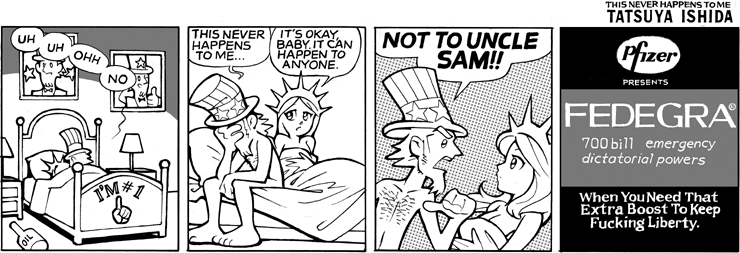
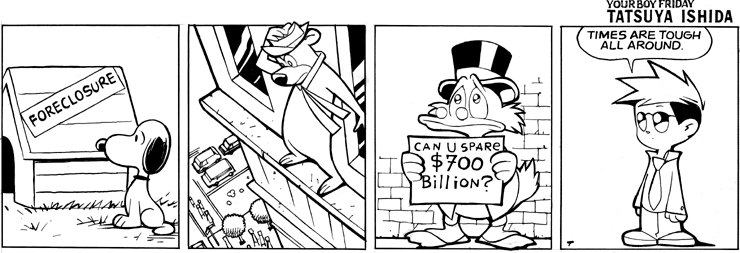
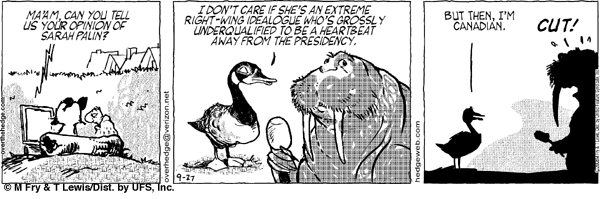
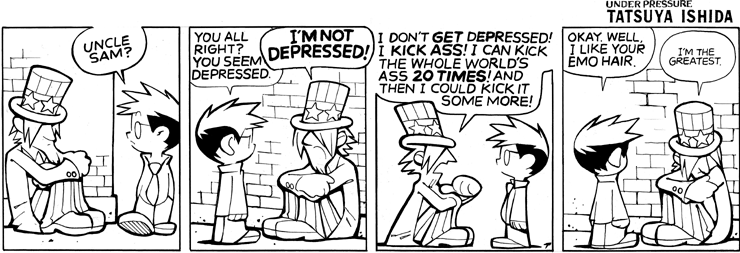
I love Sinfest

Posted on September 29, 2008 By admin

All of these come from Sinfest. If I thought I’d have trouble going into the US next time I travel, this man is for sure going to be deported to Guantanamo Bay :)


uncategorized

The more I read about Sarah Palin, the more I hope she doesn’t come close to the White House

Posted on September 29, 2008 By admin

Sarah Palin is scary. She has no experience, is a complete right-wing nutjob and would put many religious fundies to shame… And if the republicans win, she’s second in line to the throne, behind the oldest president at his inauguration.

Sleep well, kiddies.

uncategorized

Democracy works, kinda, except in the US.

Posted on September 27, 2008 By admin

In the land of the free, it is possible to win the popular vote and lose the electoral vote, and therefore the election. It is also possible to win the election with less than 50% of the voting population. Both of these scenarios, as well as others, have happened in actual elections.

There have been 12 Presidential elections that were decided by less than a 1% margin; meaning if less than 1% of the voters in certain states had changed their mind to the other candidate the outcome of the entire election would have been different.

Case and point: in 2000, if only 269 Floridians had voted with their heads instead of with their ass (or if the hanging chad issue hadn’t stolen the election), Al Gore would have won the election and the Dubya era would only have been a bad what-if scenario.

Source: https://www.msu.edu/~sheppa28/elections.html#2004

uncategorized

If that’s his campaign stand, he’s doomed

Posted on September 9, 2008 By admin

Fighting back against McCain and Palin’s effort to paint themselves as mavericks rolling up their sleeves for a Washington housecleaning, Obama today charged Palin with flip-flopping on her opposition to Alaska’s infamous “Bridge to Nowhere” project. And in some of his strongest language yet, Obama suggested that, in its new ad, the McCain-Palin ticket was simply trying to “make stuff up”.

You can’t just recreate yourself,” said the Democratic nominee. “You can’t just reinvent yourself. The American people aren’t stupid.”

They are. And if you’re basing your hopes on getting elected on this fact, you’re fucked mate.

uncategorized

Reason #49,367 to not travel to the US anymore

Posted on August 20, 2008August 20, 2008 By admin

TSA Snafu Damages Nine Planes at O’Hare Field – Pilots Furious with Misstep

Nine American Eagle airplanes were grounded Tuesday after a TSA inspector, conducting an overnight security check, used sensitive instrument probes to climb onto the parked aircraft at Chicago’s O’Hare Airport. A TSA official confirmed the incident.

The TSA agent, as part of spot inspection of aircraft security, climbed onto the parked aircraft using control sensors mounted on the fuselage as handholds, according to a TSA official.

“Our inspector was following routine procedure for securing the aircraft that were on the tarmac,” said the official. The TSA agent was attempting to determine if someone could break into a parked aircraft, according to the agent.

Pilots were furious at the TSA misstep.

“The brilliant employees used an instrument located just below the cockpit window that is critical to the operation of the onboard computers,” one pilot wrote on an American Eagle internet forum. “They decided this instrument, the TAT probe, would be adequate to use as a ladder,” the pilot wrote.

Another pilot wrote the TSA agents, “are now doing things to our aircraft that may put our lives, and the lives of our passengers at risk.”

The TSA has been conducting such overnight spot checks at airports around the country.

Source: ABC

uncategorized

If this is the land of the free, they can keep it!

Posted on August 1, 2008 By admin

Remind me to never, ever, ever again to to the US. If this is the land of the free, they can shove it where the sun don’t shine.

Federal agents may take a traveler’s laptop or other electronic device to an off-site location for an unspecified period of time without any suspicion of wrongdoing, as part of border search policies the Department of Homeland Security recently disclosed.

Also, officials may share copies of the laptop’s contents with other agencies and private entities for language translation, data decryption or other reasons, according to the policies, dated July 16 and issued by two DHS agencies, U.S. Customs and Border Protection and U.S. Immigration and Customs Enforcement.

“The policies . . . are truly alarming,” said Sen. Russell Feingold (D-Wis.), who is probing the government’s border search practices. He said he intends to introduce legislation soon that would require reasonable suspicion for border searches, as well as prohibit profiling on race, religion or national origin.

DHS officials said that the newly disclosed policies — which apply to anyone entering the country, including U.S. citizens — are reasonable and necessary to prevent terrorism. Officials said such procedures have long been in place but were disclosed last month because of public interest in the matter.

Civil liberties and business travel groups have pressed the government to disclose its procedures as an increasing number of international travelers have reported that their laptops, cellphones and other digital devices have been taken — for months, in at least one case — and their contents examined.

The policies state that officers may “detain” laptops “for a reasonable period of time” to “review and analyze information.” This may take place “absent individualized suspicion.”

The policies cover “any device capable of storing information in digital or analog form,” including hard drives, flash drives, cell phones, iPods, pagers, beepers, and video and audio tapes. They also cover “all papers and other written documentation,” including books, pamphlets and “written materials commonly referred to as ‘pocket trash’ or ‘pocket litter.’ “

Reasonable measures must be taken to protect business information and attorney-client privileged material, the policies say, but there is no specific mention of the handling of personal data such as medical and financial records.

When a review is completed and no probable cause exists to keep the information, any copies of the data must be destroyed. Copies sent to non-federal entities must be returned to DHS. But the documents specify that there is no limitation on authorities keeping written notes or reports about the materials.

“They’re saying they can rifle through all the information in a traveler’s laptop without having a smidgen of evidence that the traveler is breaking the law,” said Greg Nojeim, senior counsel at the Center for Democracy and Technology. Notably, he said, the policies “don’t establish any criteria for whose computer can be searched.”

Customs Deputy Commissioner Jayson P. Ahern said the efforts “do not infringe on Americans’ privacy.” In a statement submitted to Feingold for a June hearing on the issue, he noted that the executive branch has long had “plenary authority to conduct routine searches and seizures at the border without probable cause or a warrant” to prevent drugs and other contraband from entering the country.

Homeland Security Secretary Michael Chertoff wrote in an opinion piece published last month in USA Today that “the most dangerous contraband is often contained in laptop computers or other electronic devices.” Searches have uncovered “violent jihadist materials” as well as images of child pornography, he wrote.

With about 400 million travelers entering the country each year, “as a practical matter, travelers only go to secondary [for a more thorough examination] when there is some level of suspicion,” Chertoff wrote. “Yet legislation locking in a particular standard for searches would have a dangerous, chilling effect as officers’ often split-second assessments are second-guessed.”

The emphasis is mine, but it’s still disgusting. They say that it’s for the good of the people. That’s like saying “only the guilty have something to fear”. All hail Big Brother! It’s in the same vein as killing off all of Usenet in order to get rid of a few hundred binary newsgroups. It’s like using a shotgun to kill a fly – as subtle, as effective and as smart.

Source: Washington Post

uncategorized

Airport scans for illegal downloads on iPods, mobile phones and laptops

Posted on July 11, 2008 By admin

Found this in the Telegraph, via Gizmondo.

This makes me sick, and violently angry. This is just another nail in the coffin of common sense, and it is another way to prove my point that industry giants will spend millions of dollars on lobbying to try and save a few thousands of dollars in losses – the end result of which means that life gets more difficult for John Q. Public.

IPods, mobile phones and laptops could be examined by airport customs officials for illegal downloads under strict new counterfeiting measures being considered by G8 governments this week, it is claimed. The measures form part of an international agreement aimed at stamping out piracy, but there are fears that individuals who have illegally downloaded songs or video clips on to MP3 players and phones for personal use could also be caught out.

They coincide with plans by the European Parliament for Internet Service Providers to be held liable if their users download illegal content, and in extreme cases, forced to disconnect people who are doing so. Illegal downloading and piracy represents the biggest single problem faced by the music, film and publishing industries, and many have been lobbying governments to introduce tough new rules to help stamp out the practice.

Earlier this month, Virgin Media resorting to writing to customers warning them that their internet services would be terminated if they persisted in file sharing. So far, little has been revealed about the Anti-Counterfeiting Trade Agreement being considered by the G8 nations, apart from a mention in the organisation’s “Declaration on the World Economy” published this week.

Backing the development of the new agreement, it said: “Effective promotion and protection of Intellectual Property Rights are critical to the development of creative products, technologies and economies.”

A leak to a technology website revealed that the focus of Acta was “border measures, particularly how to deal with large-scale intellectual property infringements, which can frequently involve criminal elements”.

However, a footnote saying that those signing up to Acta should put in place “provisions related to criminal enforcement and border measures to be applied at least in cases of trademark counterfeiting and copyright piracy”, has generated intense speculation about what it could mean for the individual. Recent research by the British Music Rights group found that the average teenager and student has 800 illegal downloads on their MP3 player. The suggestion that the new laws could be used by customs to scan MP3 players, mobiles and laptops for illegal downloads is just one of a number of potential measures that is causing concern in the technology world, leading to fevered debate about the implications on a number of websites.

Another is that mobile phone companies could contact their customers to warn them off sharing video clips. However, a source representing record labels said the practice of checking iPods and phones was unworkable.

“It is more likely to be about customs having the powers to intercept large shipments of raw materials and vast packages of MP3s with prerecorded content,” he said.

uncategorized

Yet another reason why I will not travel to the US anymore

Posted on June 26, 2008 By admin

Seizing Laptops and Cameras Without Cause

Returning from a brief vacation to Germany in February, Bill Hogan was selected for additional screening by customs officials at Dulles International Airport outside Washington, D.C. Agents searched Hogan’s luggage and then popped an unexpected question: Was he carrying any digital media cards or drives in his pockets? “Then they told me that they were impounding my laptop,” says Hogan, a freelance investigative reporter whose recent stories have ranged from the origins of the Iraq war to the impact of money in presidential politics.

Shaken by the encounter, Hogan says he left the airport and examined his bags, finding that the agents had also removed and inspected the memory card from his digital camera. “It was fortunate that I didn’t use that machine for work or I would have had to call up all my sources and tell them that the government had just seized their information,” he said. When customs offered to return the machine nearly two weeks later, Hogan told them to ship it to his lawyer.

The extent of the program to confiscate electronics at customs points is unclear. A hearing Wednesday before the Senate Committee on the Judiciary’s Subcommittee on the Constitution hopes to learn more about the extent of the program and safeguards to traveler’s privacy. Lawsuits have also been filed, challenging how the program selects travelers for inspection. Citing those lawsuits, Customs and Border Protection, a division of the Department of Homeland Security, refuses to say exactly how common the practice is, how many computers, portable storage drives, and BlackBerries have been inspected and confiscated, or what happens to the devices once they are seized. Congressional investigators and plaintiffs involved in lawsuits believe that digital copies – so-called “mirror images” of drives – are sometimes made of materials after they are seized by customs.

A ruling this year by the 9th Circuit Court of Appeals found that DHS does indeed have the authority to search electronic devices without suspicion in the same way that it would inspect a briefcase. The lawsuit that prompted the ruling was the result of more than 20 cases, most of which involved laptops, cellphones, or other electronics seized at airports. In those cases, nearly all of the individuals were of Muslim, Middle Eastern, or South Asian background.

Travelers who have their computers seized face real headaches. “In a February survey of its membership, the Association of Corporate Travel Executives found that 7 percent said they’ve had electronic devices seized at the U.S. border. It immediately deprives an executive or company of the very data – and revenue – a business trip was intended to create,” says Susan Gurley, head of the ACTE, which is asking DHS for greater transparency and oversight to protect copied data. “As a businessperson returning to the U.S., you may find yourself effectively locked out of your electronic office indefinitely.” While Hogan had his computer returned after only a few days, others say they have had theirs held for months at a time. As a result, some companies have instituted policies that require employees to travel with clean machines: free of corporate data.

The security value of the program is unclear, critics say, while the threats to business and privacy are substantial. If drives are being copied, customs officials are potentially duplicating corporate secrets, legal records, financial data, medical files, and personal E-mails and photographs as well as stored passwords for accounts from Netflix to Bank of America. DHS contends that travelers’ computers can also contain child pornography, intellectual property offenses, or terrorist secrets.

It makes practical sense to X-ray the contents of checked and carry-on luggage, which could pose an immediate danger to airplanes and their passengers. “Generally speaking, customs officials do not go through briefcases to review and copy paper business records or personal diaries, which is apparently what they are now doing now in digital form – these PDAs don’t have bombs in them,” says Marc Rotenberg, executive director of the Electronic Privacy Information Center. More troubling is what could happen if other countries follow the lead of the United States. Imagine, for instance, if China or Russia began a program to seize and duplicate the contents of traveler’s laptops. “We wouldn’t be in a position to strongly object to that type of behavior,” Rotenberg says. Indeed, visitors to the Beijing Olympic Games have been officially advised by U.S. officials that their laptops may be targeted for duplication or bugging by Chinese government spies hoping to steal business and trade secrets.

Senator Sam Brownback, a Kansas Republican, agreed that CBP needs more authority to conduct searches at the border than other law enforcement officials have inside the U.S. Only in a few cases, such as strip searches, are CBP officials required to have suspicions of illegal activity, he noted. “I hope we can go through this on the basis of protecting an individual’s rights, but also looking at trying to protect the country,” Brownback said. However, Brownback said he would not want his BlackBerry searched by border agents.

Lee Tien, a senior staff attorney with the Electronic Frontier Foundation (EFF), acknowledged that border agents have more power to conduct searches than internal U.S. police. But searching and seizing laptops, which often contain an “autobiography” of their owners, should be considered unreasonable and invasive under the U.S. Constitution’s Fourth Amendment banning such searches, he said.

“EFF does not dispute that the Fourth Amendment works differently at the border,” Tien said. “But ‘differently’ does not mean ‘not at all.'”

uncategorized

Posts pagination

Previous 1 … 9 10 11 12 Next

Power to the beaver!

Show me the beaver!
June 2026
M T W T F S S
1234567
891011121314
15161718192021
22232425262728
2930  
« May    

Quote of the day

"Some people are heroes. And some people jot down notes."
--(Terry Pratchett, The Truth)

Random Posts

  • Sharing bites
  • What the heck did she do to herself?
  • That's gotta hurt!
  • Holy crap, I’m British!
  • jaysus…
reading leopard

Tags

bobble the little blue owl boobies brought to you by the fda cats chonk christmas comics computers are evil covid-19 dealing with idiots dilbert dog ducks galleries geek god bless the land of the free holidays house I am Canadian land of cheese and chocolate linked news lolcat london news from the stupid not my dog nsfw pets pictures potd2014 qotd random shit re-member recipes relationship shrill slice of life stress Tao the british way The Peanut things i miss travel video wine work

Archives

Meta

  • Log in
  • Entries feed
  • Comments feed
  • WordPress.org

Copyright © 2026 The beaver is a proud and noble animal.

Powered by PressBook Premium theme