Skip to content
The beaver is a proud and noble animal

The beaver is a proud and noble animal

Notes from a bemused canuck

  • Home
  • About
  • Bookmarks
  • Pictures
  • Resume
  • Wine
  • Random Recipe
  • Toggle search form

Tag: the british way

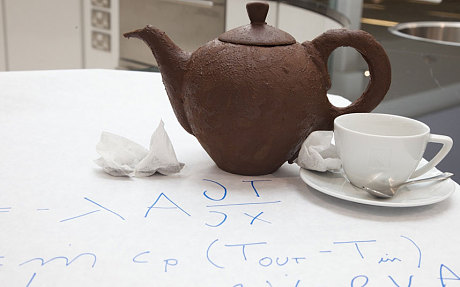
Nestlé made a functional chocolate teapot

Posted on September 8, 2014 By admin

image

A chocolate teapot is not as useless as the old saying suggests as scientists have shown it is possible to use one to brew tea – provided you do not stir it.

Master chocolatier John Costello and his team from the Nestle Product Technology Centre (PTC), in York, were given the challenge of turning the familiar idiom on its head.

Mr Costello enlisted some of the PTC’s top scientists and engineers to help in its development and solved the problem after a range of experiments.

He said they found that the secret was to use dark chocolate with 65% chocolate solids, due to its fat content, and build up a series of layers using a silicon mould.  Doing so, they could create a teapot that was able to withstand boiling water to let the tea brew for two minutes before pouring.

“Interestingly, if you pour the water in a certain way and you don’t stir inside, and you just let it settle, and let it brew like you would normally brew a cup of tea, and just let it stand for a little while – when you pour it, what happens is that the chocolate on the inside of the shell melts but doesn’t move anywhere.

“It stays where it is. So you get a very, very small amount of residue coming up to the top.”

Tasting the final brew, the team concluded it was a lovely cup of tea with a slight hint of chocolate.

The PTC in York is Nestle’s global centre for confectionery research and development and has 185 staff.


uncategorized

Why boarding schools produce bad leaders

Posted on September 1, 2014 By admin

In reply to a few snarky comments I got on a recent post about British elitism, I give you this recent article from the Guatrdian (emphasis mine):

The elite tradition is to send children away at a young age to be educated. But future politicians who suffer this ‘privileged abandonment’ often turn out as bullies or bumblers.

In Britain, the link between private boarding education and leadership is gold-plated. If their parents can afford it, children are sent away from home to walk a well-trodden path that leads straight from boarding school through Oxbridge to high office in institutions such as the judiciary, the army, the City and, especially, government. Our prime minister was only seven when he was sent away to board at Heatherdown preparatory school in Berkshire. Like so many of the men who hold leadership roles in Britain, he learned to adapt his young character to survive both the loss of his family and the demands of boarding school culture. The psychological impact of these formative experiences on Cameron and other boys who grow up to occupy positions of great power and responsibility cannot be overstated. It leaves them ill-prepared for relationships in the adult world and the nation with a cadre of leaders who perpetuate a culture of elitism, bullying and misogyny affecting the whole of society.

Nevertheless, this golden path is as sure today as it was 100 years ago, when men from such backgrounds led us into a disastrous war; it is familiar, sometimes mocked, but taken for granted. But it is less well known that costly, elite boarding consistently turns out people who appear much more competent than they actually are. They are particularly deficient in non-rational skills, such as those needed to sustain relationships, and are not, in fact, well-equipped to be leaders in today’s world

I have been doing psychotherapy with ex-boarders for 25 years and I am a former boarding-school teacher and boarder. My pioneering study of privileged abandonment always sparks controversy: so embedded in British life is boarding that many struggle to see beyond the elitism and understand its impact. The prevalence of institutionalised abuse is finally emerging to public scrutiny, but the effects of normalised parental neglect are more widespread and much less obvious. Am I saying, then, that David Cameron, and the majority of our ruling elite, were damaged by boarding?

It’s complex. My studies show that children survive boarding by cutting off their feelings and constructing a defensively organised self that severely limits their later lives. Cameron, Boris Johnson, Jeremy Hunt, Andrew Mitchell, Oliver Letwin et al tick all the boxes for being boarding-school survivors. For socially privileged children are forced into a deal not of their choosing, where a normal family-based childhood is traded for the hothousing of entitlement. Prematurely separated from home and family, from love and touch, they must speedily reinvent themselves as self-reliant pseudo-adults.

Paradoxically, they then struggle to properly mature, since the child who was not allowed to grow up organically gets stranded, as it were, inside them. In consequence, an abandoned child complex within such adults ends up running the show. This is why many British politicians appear so boyish. They are also reluctant to open their ranks to women, who are strangers to them and unconsciously held responsible for their abandonment by their mothers. With about two-thirds of the current cabinet from such a background, the political implications of this syndrome are huge – because it’s the children inside the men running the country who are effectively in charge.

Boarding children invariably construct a survival personality that endures long after school and operates strategically. On rigid timetables, in rule-bound institutions, they must be ever alert to staying out of trouble. Crucially, they must not look unhappy, childish or foolish – in any way vulnerable – or they will be bullied by their peers. So they dissociate from all these qualities, project them out on to others, and develop duplicitous personalities that are on the run, which is why ex-boarders make the best spies.

Now attached to this internal structure instead of a parent, the boarding child survives, but takes into adulthood a permanent unconscious anxiety and will rarely develop what Daniel Goleman calls emotional intelligence. In adulthood he sticks to the same tactics: whenever he senses a threat of being made to look foolish, he will strike. We see this in Cameron’s over-reaction to Angela Eagle MP, less than a year into his new job. “Calm down, dear!” the PM patronisingly insisted, as if she were the one upset and not he. The opposite benches loved it, of course, howling “Flashman!” (the public school bully from Tom Brown’s Schooldays), but they never take on the cause of these leadership defects.

Bullying is inevitable and endemic in 24/7 institutions full of abandoned and frightened kids. Ex-boarders’ partners often report that it ends up ruining home life, many years later. Bullying pervades British society, especially in politics and the media, but, like boarding, we normalise it. When, in 2011, Jeremy Clarkson ranted that he would have striking public-sector workers shot, he was even defended by Cameron – it was apparently a bit of fun. No prizes for guessing where both men learned their styles. And no wonder that the House of Commons, with its adversarial architecture of Victorian Gothic – just like a public school chapel – runs on polarised debate and bullying.

Strategic survival has many styles: bullying is one; others include keeping your head down, becoming a charming bumbler, or keeping an incongruently unruffled smile in place, like health secretary Jeremy Hunt, former head boy at Charterhouse. In a remarkable 1994 BBC documentary called The Making of Them, whose title I borrowed for my first book, young boarders were discreetly filmed over their first few weeks at prep school. Viewers can witness the “strategic survival personality” in the process of being built. “Boarding school,” says nine-year-old Freddy, puffing himself up, putting on his Very Serious Face and staring at the camera, “has changed me, and the one thing I can do now is get used [to it]”. This false independence, this display of pseudo-adult seriousness is as evident in the theatrical concern of Cameron as it was in Tony Blair. It displays the strategic duplicity learned in childhood; it is hard to get rid of, and, disastrously, deceives even its creator.

The social privilege of boarding is psychologically double-edged: it both creates shame that prevents sufferers from acknowledging their problems, as well as unconscious entitlement that explains why ex-boarder leaders are brittle and defensive while still projecting confidence. Boris is so supremely confident that he needs neither surname nor adult haircut; he trusts his buffoonery to distract the public from what Conrad Black called “a sly fox disguised as a teddy bear”. On the steps of St Paul’s, Boris commanded the Occupy movement: “In the name of God and Mammon, go!” Was it a lark – Boris doing Monty Python? Or a coded message, announcing someone who, for 10 years, heard the King James Bible read in chapel at Eton? Those who don’t recognise this language, it suggests, have no right to be here, so they should just clear off.

This anachronistic entitlement cannot easily be renounced: it compensates for years without love, touch or family, for a personality under stress, for the lack of emotional, relational and sexual maturation. In my new book, Wounded Leaders, I trace the history of British elitism and the negative attitude towards children to colonial times and what I call the “rational man project”, whose Victorian boarding schools were industrial power stations churning out stoic, superior leaders for the empire.

Recent evidence from neuroscience experts shows what a poor training for leaderships this actually is. In short, you cannot make good decisions without emotional information (Professor Antonio Damasio); nor grow a flexible brain without good attachments (Dr Sue Gerhardt); nor interpret facial signals if your heart has had to close down (Professor Stephen Porges); nor see the big picture if your brain has been fed on a strict diet of rationality (Dr Iain McGilchrist). These factors underpin Will Hutton’s view that “the political judgments of the Tory party have, over the centuries, been almost continuously wrong”.

With survival but not empathy on his school curriculum from age seven, Cameron is unlikely to make good decisions based on making relationships in Europe, as John Major could. He can talk of leading Europe, but not of belonging to it. Ex-boarder leaders cannot conceive of communal solutions, because they haven’t had enough belonging at home to understand what it means. Instead, they are limited to esprit de corps with their own kind. In order to boost his standing with the rightwingers in his party, Cameron still thinks he can bully for concessions, make more supposedly “robust” vetos.

His European counterparts don’t operate like this. Angela Merkel has held multiple fragile coalitions together through difficult times by means of her skill in relationships and collaboration. Though deadlocked at home, Barack Obama impressed both sides of British politics and in 2009 entered the hostile atmosphere of the Kremlin to befriend the then-president Dmitry Medvedev and make headway on a difficult disarmament treaty. In a subsequent meeting with the real power behind the throne, Obama invited Vladimir Putin to expound for an hour on what hadn’t worked in recent Russian-American relationships, before responding. Despite their elitist education, and because of it, our own “wounded leaders” can’t manage such statesmanship.

To change our politics, we’ll have to change our education system. Today, most senior clinicians recognise boarding syndrome, several of whom recently signed a letter to the Observer calling for the end of early boarding.

uncategorized

Oh conservatives, how you make me laugh (and cry)

Posted on April 29, 2014 By admin

A pheasant shot in a field

A few days after it was revealed that an NHS group is considering charging patients for the crutches, walking sticks and neck braces it issues, we discovered that David Cameron has intervened to keep the cost of gun licences frozen at £50: a price that hasn’t changed since 2001. The police are furious: it costs them £196 to conduct the background checks required to ensure shotguns are issued only to the kind of dangerous lunatics who use them for mowing down pheasants, rather than to the common or garden variety. As a result they – sorry, we – lose £17m a year, by subsidising the pursuits of the exceedingly rich.

The Country Land and Business Association – the armed wing of the Conservative party – complains that it’s simply not fair to pass on the full cost of the licence to the owners of shotguns; unlike, say, the owners of passports or driving licences, who are charged on the basis of full cost recovery.

Three days later the government announced it would raise the subsidy it provides for grouse moors from £30 per hectare to £56. Yes, you read that right: the British government subsidises grouse moors, which are owned by 1% of the 1% and used by people who are scarcely less rich.

While the poor are being forced out of their homes through government cuts, it is raising the payments – across hundreds of thousands of hectares – that some owners use to burn and cut the land (helping to cause floods downstream), shoot or poison hen harriers and other predators, and scar the hills with roads and shooting butts.

While the rest of us can go to the devil, the interests of the very rich are ringfenced.

Before examining the wider picture, let’s stick with the shooting theme for a moment, and take a look at the remarkable shape-shifting properties of that emblem of Downton Abbey Britain: the pheasant. Through a series of magnificent legal manoeuvres it can become whatever the nation’s wealthy want it to be.

When pheasants are reared, they are classed as livestock: that means the people who raise them are exempt from some payments of value added tax and certain forms of planning control, on the grounds that they are producing food.

But as soon as they’re released they are classed as wild animals. Otherwise you wouldn’t be allowed to shoot them. But if you want to re-capture the survivors at the end of the shooting season to use as breeding stock, they cease to be wild and become livestock again, because you aren’t allowed to catch wild birds with nets.

If, however, pheasants cause damage to neighbouring gardens, or to cars, or to the people travelling in those cars, the person who released them bears no liability, because for this purpose they are classed as wild animals – even if, at the time, they are being rounded up as legal livestock.

The pheasant’s properties of metamorphosis should be a rich field of study for biologists: even the Greek myths mentioned no animal that mutated so often. In the treatment of pheasant and grouse shoots we see in microcosm what is happening in the country as a whole. Legally, fiscally and politically, the very rich are protected from the forces afflicting everyone else.

But to call on the government to make rational and progressive fiscal decisions, as many of us do, is to misunderstand what it is attempting. It is not seeking to save the country from fiscal ruin – there are many ways of doing that without cutting essential services. It is re-engineering the United Kingdom as a plutocrats’ paradise, in which the rich are scarcely troubled by laws or taxes, while the poor are plunged into a brutal world of casual labour, insecurity and legal restraint. It is creating a world in which the rich may live by their own rules.

So back we go to the hazy days of Edwardian England: a society dominated by rentiers, in which the city centres are set aside for those with tremendous wealth and the countryside is reserved for their bloodsports. As the queues lengthen at the foodbanks, our money is used to subsidise grouse and shotguns. That is all you need to know about how and by whom we are governed.

uncategorized

Sign you’re in england #27

Posted on May 23, 2013 By admin

The grounds team are mowing the lawn in a striped pattern while it’s pissing it down with hail.

striped_lawn

uncategorized

Some thoughts about today

Posted on January 21, 2013 By admin

The English are completely useless when there is snow on the ground.
Uk trains are the laughingstock of Europe.
I need to pee rather badly, yet I would still kill for a cup of tea.

uncategorized

Snowmaggedon

Posted on January 18, 2013January 30, 2013 By admin

image

This is the amount of snow that sent England in a blind panic. Please note that it’s been “snowing” since 10am and that the powers that be called the buses on campus at 3pm. It’s now past 11pm. I maintain that the English are snow pussies.

uncategorized

The English are pussies

Posted on January 14, 2013January 30, 2013 By admin

image

There is an inch of snow on the ground and flurries are still falling. So of course everyone is panicking and the buses are leaving 90 minutes early.

uncategorized

A country of winter pansies

Posted on December 5, 2012January 30, 2013 By admin

image

We’ve had the first snowfall of the year and, predictably, the country has lost its mind. We’ve had less than an inch – the grass is still poking through the snow – and it’s taken us 30 minutes to just get out of Saffron Walden. Oy vey.

uncategorized

Jesus walked with dinosaurs…

Posted on June 26, 2012 By admin

The debate between creationists and proponents of evolution isn’t ending any time soon, but now some creationists have a secret weapon, “Nessie!” Certain fundamentalist schools in Louisiana plan to teach children that the Loch Ness monster is real in a bid to disprove Darwin’s theory of evolution.

It sounds like a plot dreamed up by the creators of Southpark, but it’s all true: schoolchildren in Louisiana are to be taught that the Loch Ness monster is real in a bid by religious educators to disprove Darwin’s theory of evolution. Thousands of children in the southern state will receive publicly-funded vouchers for the next school year to attend private schools where Scotland’s most famous mythological beast will be taught as a real living creature.

These private schools follow a fundamentalist curriculum including the Accelerated Christian Education (ACE) programme to teach controversial religious beliefs aimed at disproving evolution and proving creationism. One tenet has it that if it can be proved that dinosaurs walked the earth at the same time as man then Darwinism is fatally flawed.

The textbooks in the series are alleged to teach young earth creationism; are hostile towards other religions and other sectors of Christianity, including Roman Catholicism; and present a biased version of history that is often factually incorrect. One ACE textbook – Biology 1099, Accelerated Christian Education Inc – reads: “Are dinosaurs alive today? Scientists are becoming more convinced of their existence. Have you heard of the ‘Loch Ness Monster’ in Scotland? ‘Nessie’ for short has been recorded on sonar from a small submarine, described by eyewitnesses, and photographed by others. Nessie appears to be a plesiosaur.”

Another claim taught is that a Japanese whaling boat once caught a dinosaur. It’s unclear if the movie Godzilla was the inspiration for this lesson.

Private religious schools, including the Eternity Christian Academy in Westlake, Louisiana, which follows the ACE curriculum, have already been cleared to receive the state voucher money transferred from public school funding, thanks to a bill pushed through by state Governor Bobby Jindal.

Boston-based researcher and writer Bruce Wilson, who specialises in the American political religious right, compares the curriculum to Islamic fundamentalist teaching. “They are being brought up to believe that they’re at war with secular society. The only valid government would be a Christian fundamentalist government. Obviously some comparisons could be made to Islamic Fundamentalists in schools. One of these texts from Bob Jones University Press claims that dinosaurs were fire-breathing dragons. It has little to do with science as we currently understand. It’s more like medieval scholasticism.”

Of course, the Scottish tourist industry might well reap a dividend from the craziness of the American education system. Nessie expert Tony Drummond, who leads tours as part of Cruise Loch Ness, has a few words of advice to the US schools in question: come to the loch and try to find the monster.

Textbooks of some state-funded Christian schools praise the Ku Klux Klan. The violent, racist organisation, which still exists in the US, advocates white supremacy, white nationalism and anti-immigration. One excerpt from Bob Jones University Press American history textbook has been reported as saying: “the [Ku Klux] Klan in some areas of the country tried to be a means of reform, fighting the decline in morality and using the symbol of the cross … In some communities it achieved a certain respectability as it worked with politicians.”

It isn’t just America where the bizarre Christian Nessie myth is being taught as a reality. The UK has similar religious schools but they do not receive cash from the state. Nevertheless, the Evangelical Christian curriculum they follow has been approved by UK Government agency, the National Recognition Information Centre (Naric) which guides universities and employers on the validity of different qualifications. Naric judged the International Certificate of Christian Education (ICCE) as officially comparable to qualifications offered by the Cambridge International exam board. It is estimated around 2000 pupils study at more than 50 private Christian schools in Britain for the certificates as well as several home-educated students.

Huh… I didn’t know that last part. Just goes to show that crazy is a universal concept.

Source: The Scotland Herald

uncategorized

The true value of money – or why you can’t fart a crashing plane back into the sky

Posted on February 13, 2012 By admin

I’m no financial expert. I scarcely know what a coin is. Ask me to explain what a credit default swap is and I’ll emit an unbroken 10-minute “um” through the clueless face of a broken puppet. You might as well ask a pantomime horse. But even an idiot such as me can see that money, as a whole, doesn’t really seem to be working any more.

Money is broken, and until we admit that, any attempts to fix the economy seem doomed to fail. We’re like passengers on a nosediving plane thinking if we all fart hard enough, we can lift it back into the sky. So should we be storming the cockpit or hunting for parachutes instead? I don’t know: I ran out of metaphor after the fart gag. You’re on your own from hereon in.

Banknotes aren’t worth the paper they’re printed on. If they were, they’d all have identical value. Money’s only worth what the City thinks it’s worth. Or, perhaps more accurately, hopes it’s worth. Coins should really be called “wish-discs” instead. That name alone would give a truer sense of their value than the speculative number embossed on them.

The entire economy relies on the suspension of disbelief. So does a fairy story, or an animated cartoon. This means that no matter how soberly the financial experts dress, no matter how dry their language, the economy they worship can only ever be as plausible as an episode of SpongeBob SquarePants. It’s certainly nowhere near as well thought-out and executed.

No one really understands how it all works: if they did, we wouldn’t be in this mess. Banking, as far as I can tell, seems to be almost as precise a science as using a slot machine. You either blindly hope for the best, delude yourself into thinking you’ve worked out a system, or open it up when no one’s looking and rig the settings so it’ll pay out illegally.

The chief difference is that slot machines are more familiar and graspable to most of us. When you hear a jackpot being paid out to a gambler, the robotic clunk-clunk-clunk of coin-on-tray, you’re aware that he had to go to some kind of effort to get his reward. You know he stood there pushing buttons for hours. You can picture that.

The recent outrage over City bonuses stems from a combination of two factors: the sheer size of the numbers involved coupled with a lack of respect for the work involved in earning them. Like bankers, top footballers are massively overpaid, but at least you comprehend what they’re doing for the money. If Wayne Rooney was paid millions to play lacrosse in a closed room in pitch darkness, people would begrudge him his millions far more than they already do. Instead there he is, on live television: he’s skilled, no doubt about it.

Similarly, it may be tasteless when a rapper pops up on MTV wearing so much bling he might as well have dipped himself in glue and jumped into a treasure chest full of vajazzling crystals, but at least you understand how he earned it.

RBS boss Stephen Hester, meanwhile, earns more than a million pounds for performing enigmatic actions behind the scenes at a publicly owned bank. And on top of his huge wage, he was in line for a massive bonus. To most people, that’s downright cheeky: like a man getting a blowjob from your spouse while asking you to make him a cup of tea.

But Hester earned his wage, we’re told, because he does an incredibly difficult job. And maybe he does. Trouble is, no one outside the City understands what his job actually consists of. I find it almost impossible to picture a day in Hester’s life, and I once wrote a short story about a pint-sized toy Womble that ran around killing dogs with its dick, so I know I don’t lack imagination. Class, yes: imagination, no. If I strain my mind’s eye, I can just about picture Hester arriving at work, picture him thanking his driver, picture the receptionist saying “Hello, Mr Hester”, and picture him striding confidently into his office – but the moment the door shuts, my feed breaks up and goes fuzzy. What does he do in there? Pull levers? Chase numbers round the room with a broom? God knows.

Maybe if all bankers were forced to work in public, on the pavement, it would help us understand what they actually do. Of course, you’d have to encase them in a Perspex box so they wouldn’t be attacked. In fact, if the experience of David Blaine is anything to go by, you’d have to quickly move that Perspex box to somewhere impossibly high up, where people can’t pelt it with golf balls and tangerines. On top of the Gherkin, say. If Hester did his job inside a Perspex box on top of the Gherkin for a year, this entire argument might never have happened.

The row over bonuses has led some to mutter darkly about mob rule and the rise of anti-business sentiment. Complain about mobs all you like, but you can’t control gut reactions, and you can’t dictate the mood. And when you try to fart a crashing plane back into the sky, you only succeed in making the atmosphere unpleasant for everyone. And spoiling the in-flight movie. And making the stewardess cry. Looks like I’m all out of metaphor again. Time to end the article. Article ends.

Emphasis mine, I like the quote.

Source: Charlie Brooker – guardian.co.uk, Sunday 12 February 2012 21.00 GMT

uncategorized

Posts pagination

Previous 1 … 6 7 8 … 14 Next

Power to the beaver!

Show me the beaver!
June 2026
M T W T F S S
1234567
891011121314
15161718192021
22232425262728
2930  
« May    

Quote of the day

"Yes," said the skull. "Quit while you're a head, that's what I say."
--(Terry Pratchett, Soul Music)

Random Posts

  • So proud :-)
  • Quote of the day
  • Hard drinking 
  • Two good comics
  • A holiday we can all get behind
reading leopard

Tags

bobble the little blue owl boobies brought to you by the fda cats chonk christmas comics computers are evil covid-19 dealing with idiots dilbert dog ducks galleries geek god bless the land of the free holidays house I am Canadian land of cheese and chocolate linked news lolcat london news from the stupid not my dog nsfw pets pictures potd2014 qotd random shit re-member recipes relationship shrill slice of life stress Tao the british way The Peanut things i miss travel video wine work

Archives

Meta

  • Log in
  • Entries feed
  • Comments feed
  • WordPress.org

Copyright © 2026 The beaver is a proud and noble animal.

Powered by PressBook Premium theme

Loading Comments...