I have written a book.
Well, actually it’s closer to 4, but the other 3 still need some editing.
But I have written a book. And I’m proud of it. It’s 152K words, over 37 chapters.
I made myself cry. I posted it to the story website I’ve been reading on for years and the feedback has been very positive. It is currently #2 on the top 50 recent long stories, with a score of 8.47/10, with 280 votes. Over 1500 people have read it to the end. I’ve had people from all over the world commenting on how my story touched them, how it was original, and encouraging my efforts. That’s pretty surreal for something that started with a 2 sentence idea.
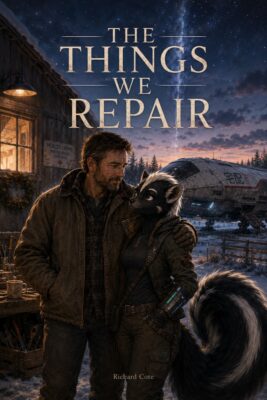
Click on the image above to download the EPUB.
Summary blurb
When Neris Vael’s courier ship tears out of dimensional transit and crashes in the forests of northern Ontario, she is stranded farther from home than anyone from her civilization has ever travelled.
Takuhai is crippled, the route back has vanished, and the ship’s intelligence, ER, can do little beyond the damaged hull. Neris’s only hope is Daniel Mercer, a widowed cattle farmer who knows nothing about alien technology but knows exactly what it means to keep broken things working.
What begins with guarded bargains, improvised parts, and a promise of secrecy becomes something none of them expected. Neris discovers a world that is technologically young, stubbornly untidy, and startlingly kind. Daniel finds his quiet life opening again after loss. And ER, built to calculate routes and risk, begins confronting questions no repair protocol can answer.
But every successful repair brings them closer to the one outcome neither Neris nor Daniel is ready to face: if they can rebuild the road home, she will have to take it.
Liner Notes
This is first-contact science fiction without the usual parade of governments, generals, or grand declarations. The first human to meet Neris is a farmer carrying a first-aid kit. Their earliest diplomacy consists of bottled water, cautious boundaries, borrowed tools, and a promise to return the next morning. The scale matters. By placing the extraordinary inside the routines of a working cattle farm, the novel asks what contact between worlds might look like before it becomes history—when it is still only two wary people deciding whether the other can be trusted.
The title names the novel’s central discipline. Repair is physical: a damaged manifold, a failing signal path, a ship forced to accept parts that were never meant to fit. It is also emotional, but never effortless. Daniel’s grief is not cured by Neris, and Neris’s isolation is not erased by finding someone who understands it. They remain capable people with their own obligations, fears, and loyalties. What changes is that each begins to let the other share the weight.
That same idea shapes ER’s development. He begins as a shipbound intelligence concerned with continuity, safety, and the measurable requirements of getting his pilot home. Yet the household forming around Takuhai creates questions that cannot be solved by optimization alone. Care introduces uncertainty. Loyalty creates competing duties. Humour becomes useful despite resisting quantification. In learning how to belong, ER becomes more fully himself without becoming less precise.
At the centre of the book is an unusual household: a stranded courier, a solitary farmer, and an intelligence who cannot leave his ship. Their intimacy develops through repeated acts of attention. Tea is remembered correctly. A porch light is left on. Tools are reorganized at an unreasonable hour. A tail’s weight becomes a form of trust. The novel allows these small gestures to carry the emotional force that another story might reserve for speeches.
The supporting community grows by the same logic. Kindness arrives imperfectly, often without full information. Again and again, the story returns to the idea that capability is not permission—and that privacy, consent, and care remain meaningful even when the stakes span worlds.
The deepest tension in The Things We Repair is not whether Neris wants to return home. She does. Her family, responsibilities, history, and identity remain real. The harder question is what happens when Earth also becomes real to her—when a temporary refuge gathers routines, relationships, and objects with emotional weight. The book refuses the easy arithmetic in which one home must invalidate the other. Home is treated as something made through attention and repeated choice: less a fixed location than a practice.
That is why the novel’s hope is inseparable from its ache. Every repaired system brings departure closer. Every step toward reunion threatens a different separation. The story does not resolve that contradiction by pretending love abolishes distance. Instead, it asks whether people can build something durable enough to survive uncertainty, silence, and the knowledge that no good choice leaves everything unchanged.
The result is a slow-burn blend of science fiction, romance, and found-family drama: technically grounded without losing warmth, emotionally intimate without becoming sentimental, and frequently funny in the dry, observant way of people who have serious work to do. Its largest ideas arrive through concrete things—coffee, cattle gates, snowstorms, fabrication limits, medical ethics, family messages, and the stubborn geometry of parts that almost fit.
Above all, The Things We Repair is a story about the difference between restoring what existed before and building what can exist next.