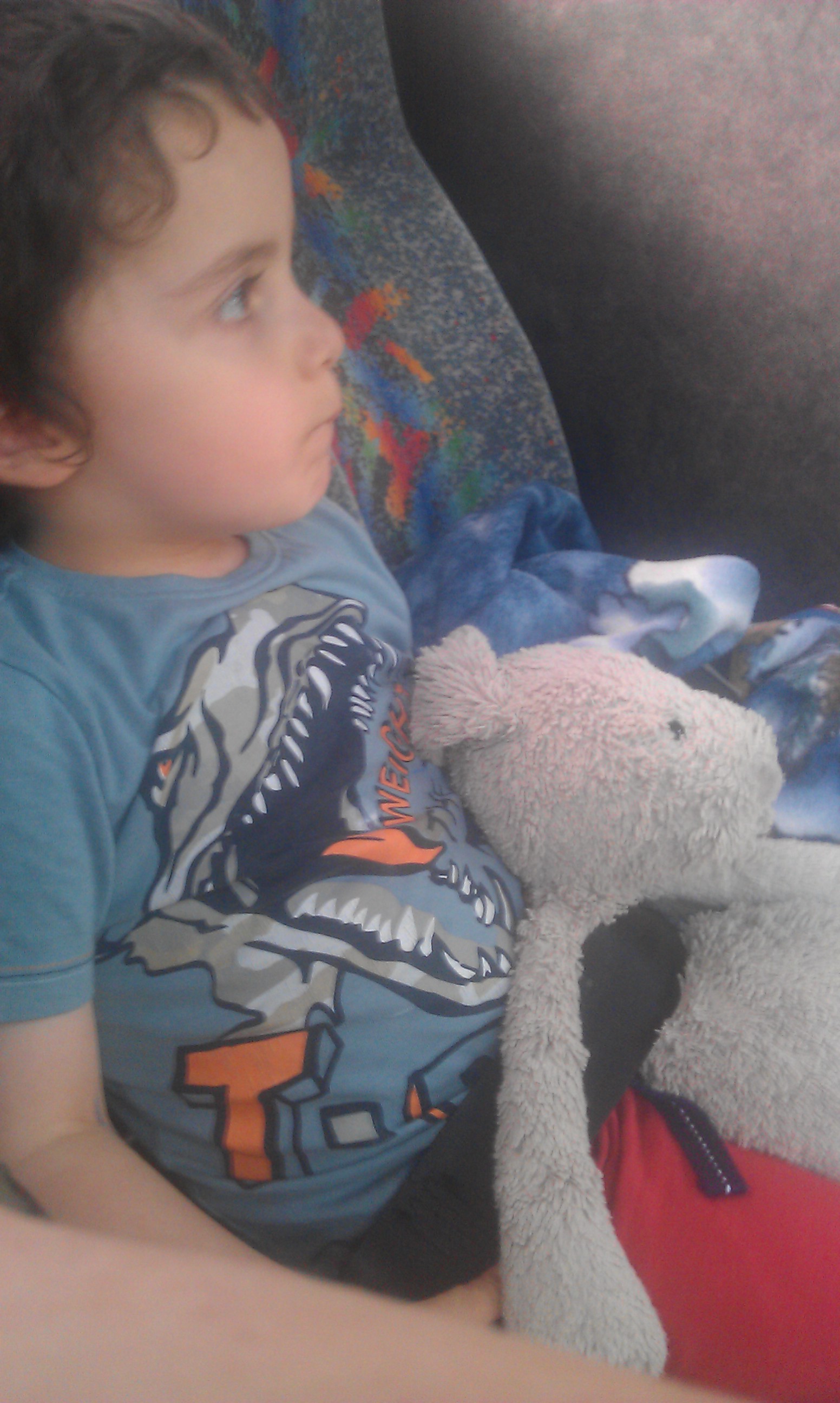
Have a tired Bean tonight. Note the safety consciousness of having both Rabbit and snowman blankie wear their seatbelts.

The beaver is a proud and noble animal
Notes from a bemused canuck
Have a tired Bean tonight. Note the safety consciousness of having both Rabbit and snowman blankie wear their seatbelts.
Today is a day where Dilbert makes more and more sense to me.



Not sure how I feel about the fact that Bean knows how to navigate around and play angry birds.. sign of the times, I guess.
About
I am filled with ennui….and Party Mix.
Personal information
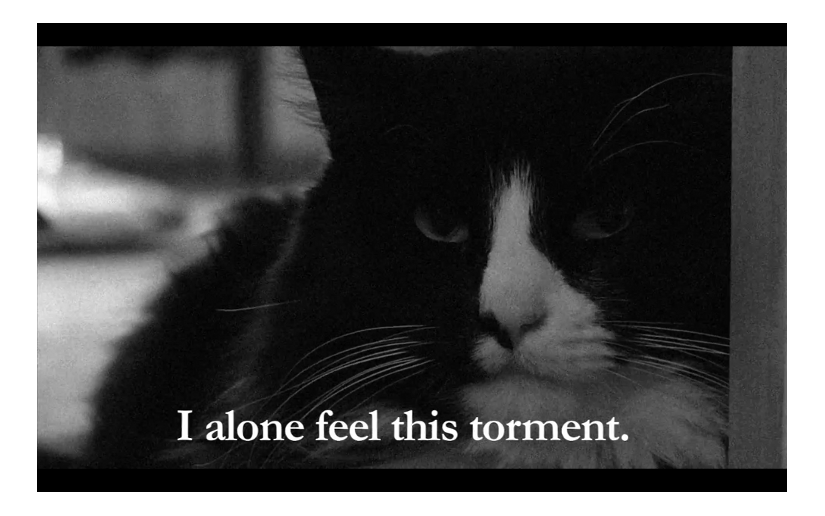
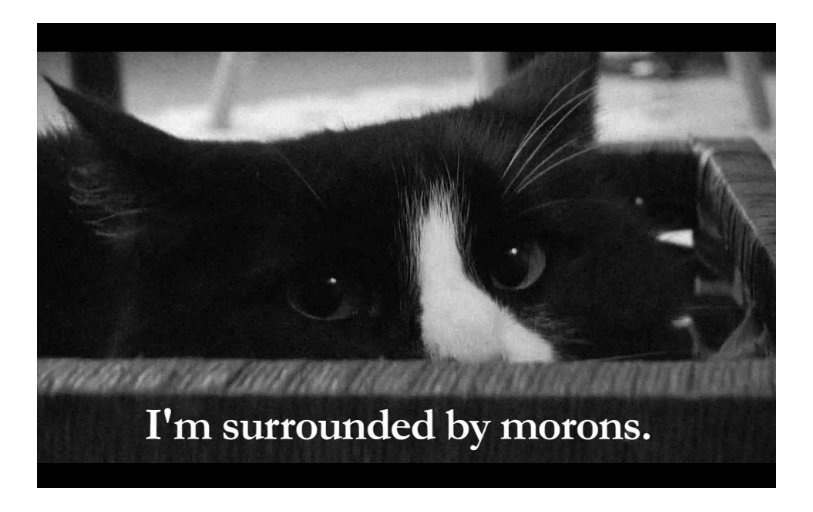
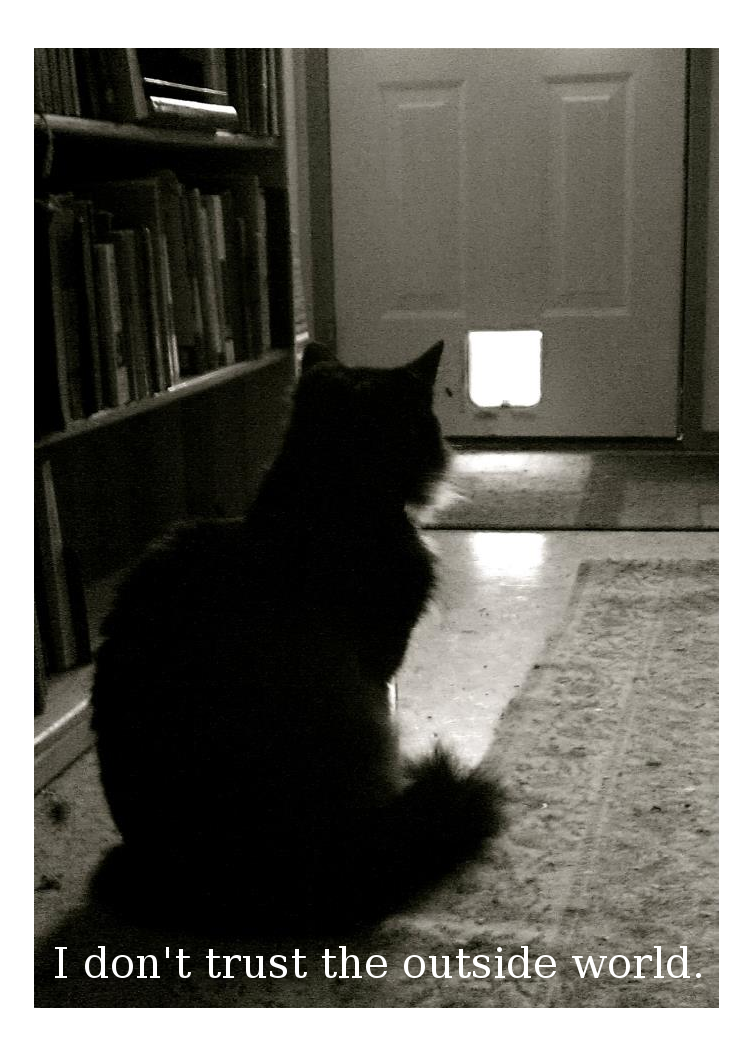
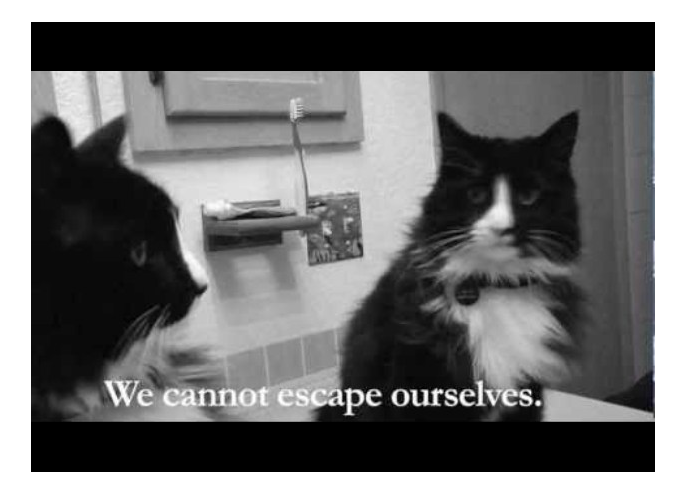
Oh, what is the point?
Personal interests
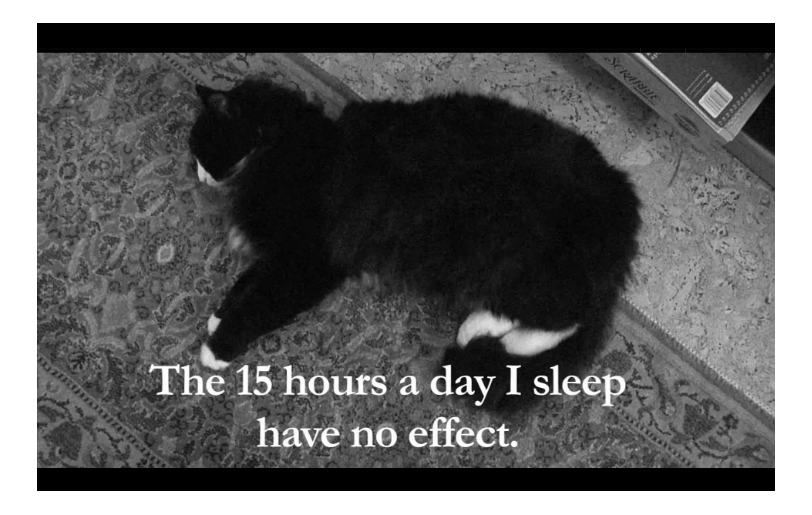
Pondering the meaningless of life…and sleeping.


When I get in the zone at work, I often tune out the music that’s playing in my headphones. This mix, however, stood out by its frank weirdness:
Supertramp – The Logical Song
Rage Against the Machine – Killing in the name of
Violent Femmes – Blister in the sun
Leonard Cohen – Everybody Knows
Judy Garland – Somewhere Over the Rainbow
Brain Damage FTW!!!

I think I’ve been an expat for too long – I completely forgot that yesterday was Canada day and that the Jazz fest is going on. Dang!

1. The Full Situp
To achieve the full situp, you must begin with the genuine intention of exercising your abs and promptly fall asleep midway through the task. This position is extremely advanced and not recommended for amateur sleepers.
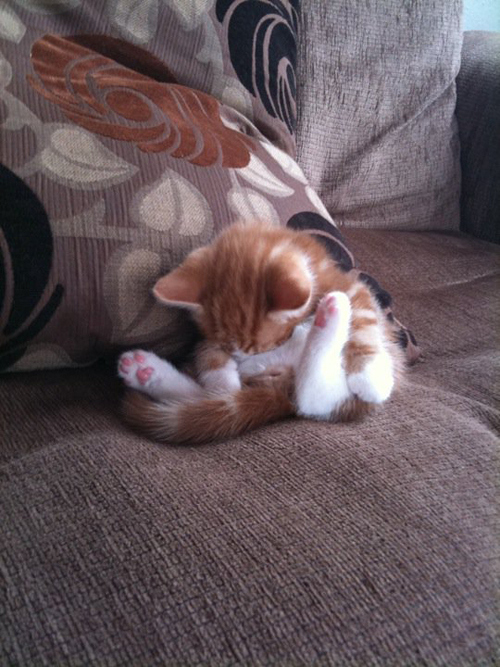
2. The Awkward Spoon
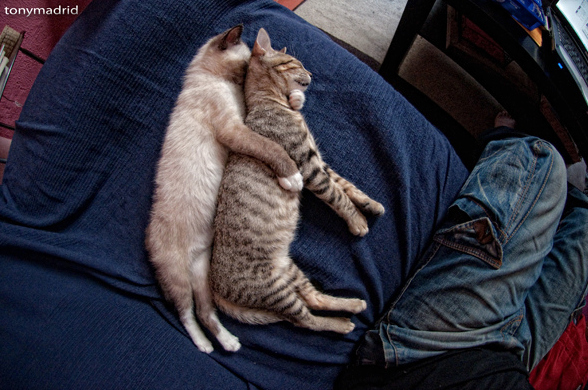
The goal here is not so much intimacy as it is the socially uncomfortable sharing of a physical space with someone. Bonus points if your arm falls asleep but you’re too embarrassed to move it.
3. The Semicircle
Tuck your tail between your legs and imagine that you are an omelet.
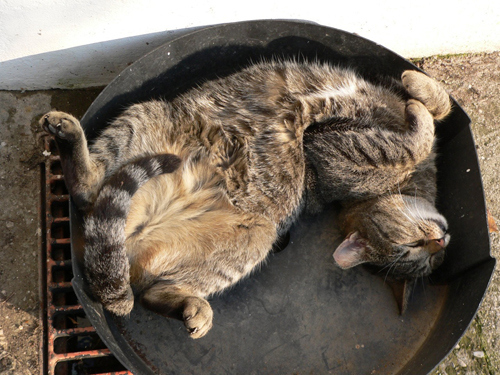
4. The Sunbather
The trick is to look like someone who is acting comfortable whilst also appearing extremely uncomfortable. Let’s take this excellent opportunity to coin the term “meta-comfortable.”
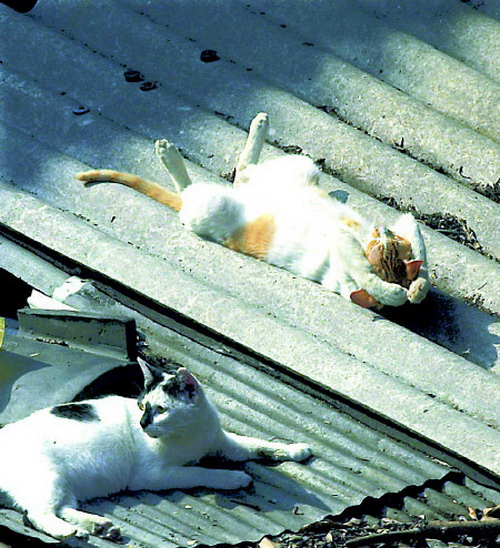
5. The Double Bed
You will need a partner for this one. The goal is not so much comfort as an expression of sheer, unadulterated greed.
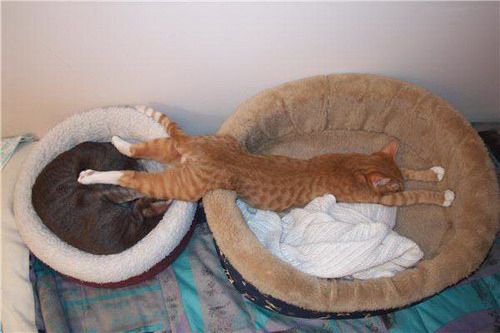
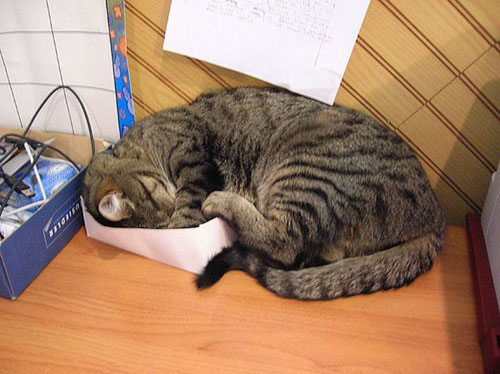
6. The Half-Box
Any old box will do, but two of your feet – preferably on opposite sides of your body – must remain outside the container at all times.
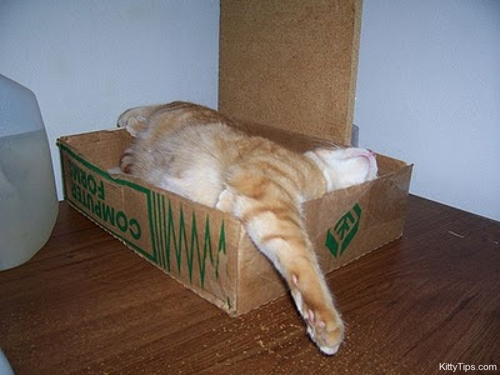
7. The Backstroker
Do not even attempt unless you have tiny, tiny, precious little legs.

8. The Sleeping Baby
Find a baby. Imitate the baby.
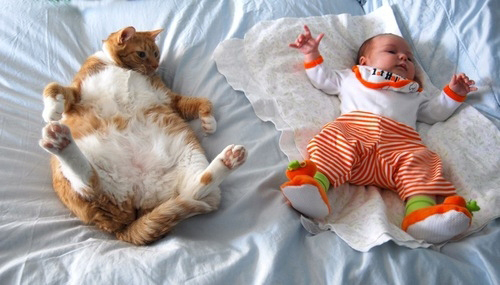
9. The Fur Pile
For this, you will need at least three friends who are not averse to your sleeping on them.

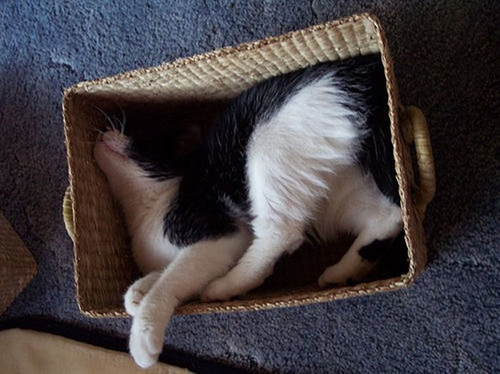
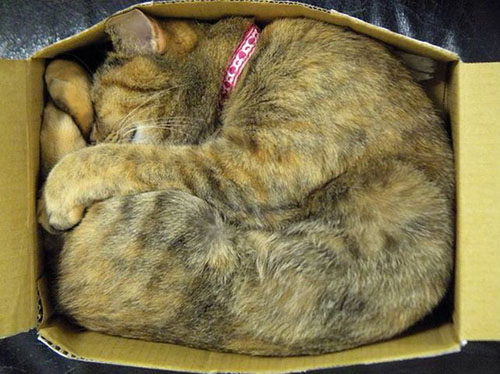
10. The Full-Box
Just get your whole damn body in there no matter what it takes. Be the box.
11. The Drunken Radiator
Just because you are obviously some kind of gin-addled hobo doesn’t mean you can’t be nice and warm.

12. The Sleeping Dog
Find a dog. Imitate the dog.

13. The Librarian
Bury your furry little head in your paws and try to look as contemplative and bookish as possible before drifting off.

14. The Ruler
Measure the floor with every inch of your tiny body.

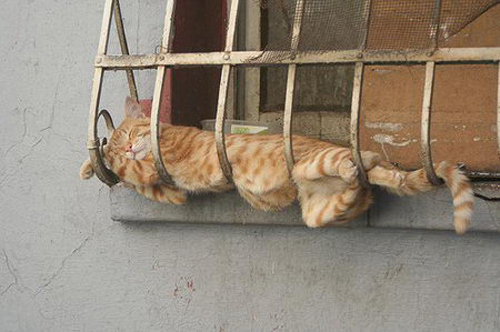
15. The Windowsill
The whole world is your hammock.
16. The Clothes Dryer
Imagine that you are a wet T-shirt, fresh from the washing machine. Drape yourself accordingly.

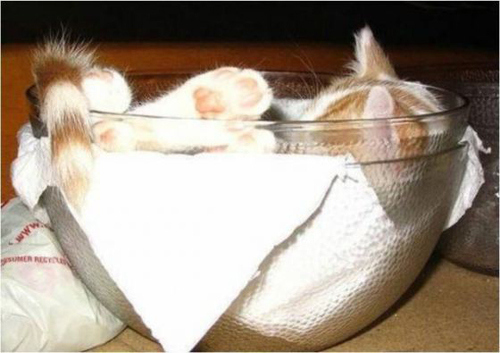
17. The Pot Luck
Think of yourself as a last-minute fruit salad that everyone will be very polite about but probably not enjoy all that much.
18. The Head-Rush
Head to the ground, paws in the air – let gravity do the rest.

19. The Odd One Out
For this one you will need first to find two willing conformists.
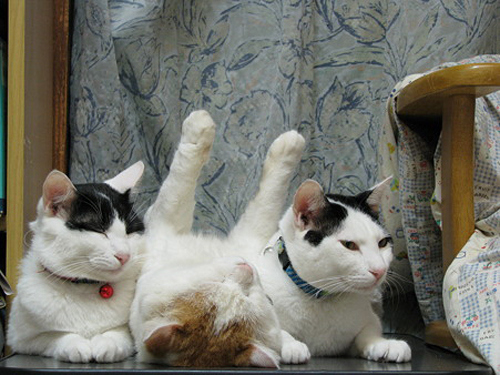
20. The Mid-Sentence
Only recommended for individuals with extreme forms of narcolepsy.

21. The Bag Of Limbs (Box Edition)
Have a friend or loved one take you apart and put you back together haphazardly inside a box.
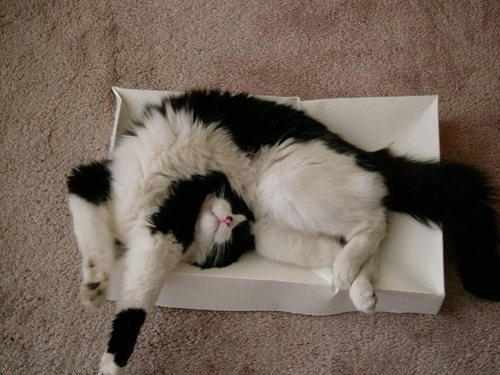
22. The Bag Of Limbs (Couch Edition)
Same as above, except (obviously) without the box.

23. The Dog Bed
Not a bed for dogs, but a bed that is made of dogs. I.e., the most comfortable bed you will ever sleep on that also smells kind of funky.

24. The Office Worker
Fall asleep on the job. LOL.

25. The Married Couple
Don’t be afraid to snore.

26. The Full Dog
For this, you will need a willing dog and preternatural sense of balance.

27. The Yin Yang
The Yin Yang sleeping position is two sides of the same coin – though you will need to decide with your partner which one of you is to be the evil one.
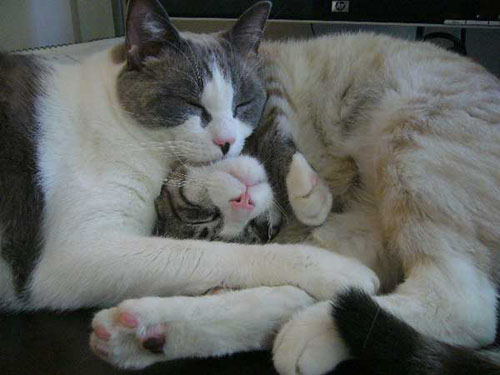
28. The Copykitten
Find a kitten. Imitate the kitten.

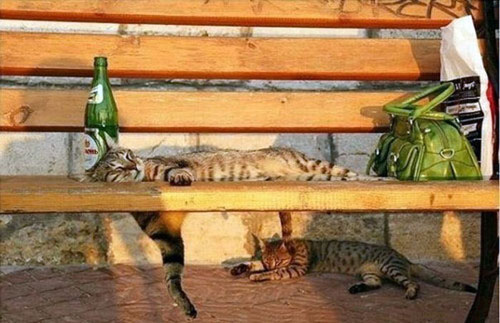
29. The Town Drunk
Alone or with a partner, this position is ideal for daytime sleeping, especially if you have already given up on pursuing a meaningful career.
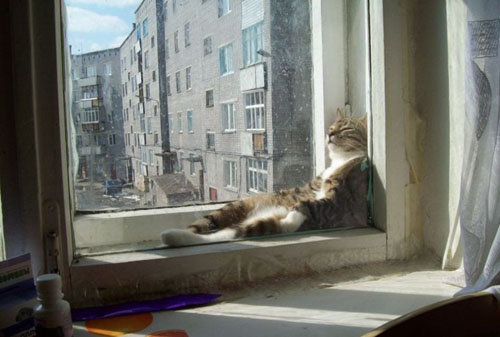
30. The Window Dressing
It is easy to find the appropriate window, and easier still to adopt the appropriate posture for this sleeping position, but it will take years of practice to fully master the knowing, world-weary expression that is its most essential component.
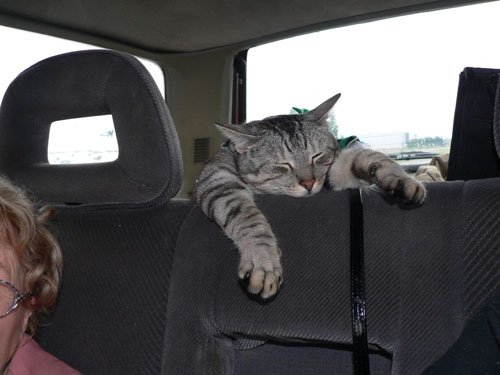
31. The Reluctant Traveler
Tire yourself out asking whether we are “there yet,” then snore as loudly as possible.
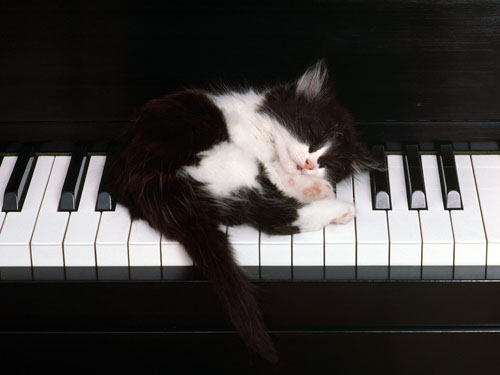
32. The Pianist
Do not even consider attempting this unless you have a Steinway or (if you are desperate) a Mason & Hamlin.
33. Between Two Stools
Any old kitchen stools will do for this one, but it’s cheating to use paws, so make sure you have strong neck muscles!

34. The Clamp
Find a friend with a strong pair of thighs and get to work.

35. The Enthusiast
Find something to celebrate and then promptly lose interest.

36. The File Drawer
File yourself under either “C” for “Cat,” or “I” for “Idiot,” depending on the filing system in your home or office.

37. The Half-Handstand
You don’t need to be fully vertical for this one, but it’s very important that your back legs be pointing optimistically skyward.

38. The Disc Jockey
The shades will prevent people from knowing that you are asleep, but they won’t help in hiding the fact that you are kind of a douchebag.

39. The Porcelain God
This one is EXTREMELY ADVANCED. Do not attempt unless you have years of practice passing out in bathrooms.

40. The Surprise Package
Remember to act like you couldn’t possibly care less when someone opens the box and finds you inside.

41. The Tight Squeeze
You will have to become very good at ignoring all the haters who are like, “Now this box is definitely too small for you, Mr. Snugglypants.”
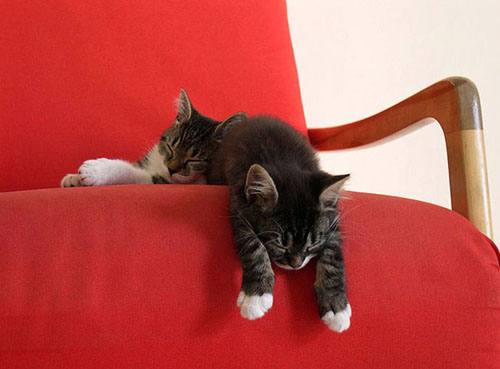
42. The Cliffhanger
Be sure to find a sleeping partner you can trust for this one, or you’ll end up as a big pile of fur underneath the chair.
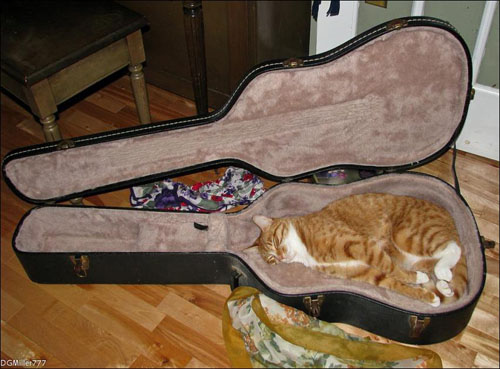
43. The Guitarist
Do not even consider attempting this unless you have a Les Paul or (if you are desperate) a Fender.
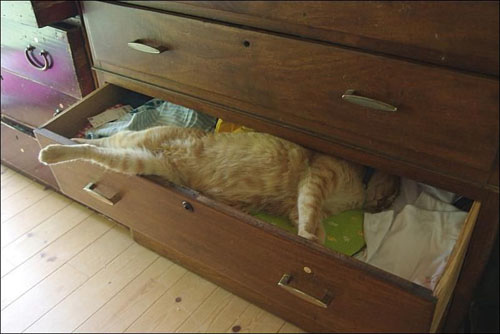
44. The Bottom Drawer
Pretend you are a pair of stripey, furry, freshly laundered boxer shorts.
45. The CD Collection
Pretend you are a discarded and long-forgotten copy of Aerosmith’s 1993 smash “Get A Grip.”

46. The Cat Scan
Lie on your back and dream of being a perfect facsimile of yourself, crisp and warm from the output tray.

47. The Undercover Squirrel
Stay very still and think very hard about acorns.

48. The Narcoleptic Gymnast
For this one, you will need a lifelong dedication to the noble sport of gymnastics and a modest supply of Ambien.

49. Big Cat, Little Box
Do not let society constrain you with their antiquated ideas about “boundaries” and “things you really, genuinely can not fit into no matter how hard you try.”
50. The Full-Sink
Let the cool porcelain soothe your back as you dream contentedly about a houseful of people temporarily unable to brush their teeth.

Pixar illustrator Josh Cooley made a collection of R-rated movie scenes in the style of a kid’s book and named it Movies R Fun. Sadly the book is sold out, but you can buy prints of the scenes from http://cooley.bigcartel.com/. Can you name all the movies these are from? I know I can. Enjoy!
UPDDATE [Feb 2014] The images in this post have been removed. See this post for an explanation.
Spoiled Rotten
Why do kids rule the roost?
by Elizabeth Kolbert July 2, 2012It almost seems as if we’re trying to raise a nation of “adultescents.”
In 2004, Carolina Izquierdo, an anthropologist at the University of California, Los Angeles, spent several months with the Matsigenka, a tribe of about twelve thousand people who live in the Peruvian Amazon. The Matsigenka hunt for monkeys and parrots, grow yucca and bananas, and build houses that they roof with the leaves of a particular kind of palm tree, known as a kapashi. At one point, Izquierdo decided to accompany a local family on a leaf-gathering expedition down the Urubamba River.
A member of another family, Yanira, asked if she could come along. Izquierdo and the others spent five days on the river. Although Yanira had no clear role in the group, she quickly found ways to make herself useful. Twice a day, she swept the sand off the sleeping mats, and she helped stack the kapashi leaves for transport back to the village. In the evening, she fished for crustaceans, which she cleaned, boiled, and served to the others. Calm and self-possessed, Yanira “asked for nothing,” Izquierdo later recalled. The girl’s behavior made a strong impression on the anthropologist because at the time of the trip Yanira was just six years old.
While Izquierdo was doing field work among the Matsigenka, she was also involved in an anthropological study closer to home. A colleague of hers, Elinor Ochs, had recruited thirty-two middle-class families for a study of life in twenty-first-century Los Angeles. Ochs had arranged to have the families filmed as they ate, fought, made up, and did the dishes.
Izquierdo and Ochs shared an interest in many ethnographic issues, including child rearing. How did parents in different cultures train young people to assume adult responsibilities? In the case of the Angelenos, they mostly didn’t. In the L.A. families observed, no child routinely performed household chores without being instructed to. Often, the kids had to be begged to attempt the simplest tasks; often, they still refused. In one fairly typical encounter, a father asked his eight-year-old son five times to please go take a bath or a shower. After the fifth plea went unheeded, the father picked the boy up and carried him into the bathroom. A few minutes later, the kid, still unwashed, wandered into another room to play a video game.
In another representative encounter, an eight-year-old girl sat down at the dining table. Finding that no silverware had been laid out for her, she demanded, “How am I supposed to eat?” Although the girl clearly knew where the silverware was kept, her father got up to get it for her.
In a third episode captured on tape, a boy named Ben was supposed to leave the house with his parents. But he couldn’t get his feet into his sneakers, because the laces were tied. He handed one of the shoes to his father: “Untie it!” His father suggested that he ask nicely.
“Can you untie it?” Ben replied. After more back-and-forth, his father untied Ben’s sneakers. Ben put them on, then asked his father to retie them. “You tie your shoes and let’s go,’’ his father finally exploded. Ben was unfazed. “I’m just asking,’’ he said.
A few years ago, Izquierdo and Ochs wrote an article for Ethos, the journal of the Society of Psychological Anthropology, in which they described Yanira’s conduct during the trip down the river and Ben’s exchange with his dad. “Juxtaposition of these developmental stories begs for an account of responsibility in childhood,” they wrote. Why do Matsigenka children “help their families at home more than L.A. children?” And “Why do L.A. adult family members help their children at home more than do Matsigenka?” Though not phrased in exactly such terms, questions like these are being asked—silently, imploringly, despairingly—every single day by parents from Anchorage to Miami. Why, why, why?
With the exception of the imperial offspring of the Ming dynasty and the dauphins of pre-Revolutionary France, contemporary American kids may represent the most indulged young people in the history of the world. It’s not just that they’ve been given unprecedented amounts of stuff—clothes, toys, cameras, skis, computers, televisions, cell phones, PlayStations, iPods. (The market for Burberry Baby and other forms of kiddie “couture” has reportedly been growing by ten per cent a year.) They’ve also been granted unprecedented authority. “Parents want their kids’ approval, a reversal of the past ideal of children striving for their parents’ approval,” Jean Twenge and W. Keith Campbell, both professors of psychology, have written. In many middle-class families, children have one, two, sometimes three adults at their beck and call. This is a social experiment on a grand scale, and a growing number of adults fear that it isn’t working out so well: according to one poll, commissioned by Time and CNN, two-thirds of American parents think that their children are spoiled.
The notion that we may be raising a generation of kids who can’t, or at least won’t, tie their own shoes has given rise to a new genre of parenting books. Their titles tend to be either dolorous (“The Price of Privilege”) or downright hostile (“The Narcissism Epidemic,” “Mean Moms Rule,” “A Nation of Wimps”). The books are less how-to guides than how-not-to’s: how not to give in to your toddler, how not to intervene whenever your teen-ager looks bored, how not to spend two hundred thousand dollars on tuition only to find your twenty-something graduate back at home, drinking all your beer.
Not long ago, Sally Koslow, a former editor-in-chief of McCall’s, discovered herself in this last situation. After four years in college and two on the West Coast, her son Jed moved back to Manhattan and settled into his old room in the family’s apartment, together with thirty-four boxes of vinyl LPs. Unemployed, Jed liked to stay out late, sleep until noon, and wander around in his boxers. Koslow set out to try to understand why he and so many of his peers seemed stuck in what she regarded as permanent “adultescence.” She concluded that one of the reasons is the lousy economy. Another is parents like her.
“Our offspring have simply leveraged our braggadocio, good intentions, and overinvestment,” Koslow writes in her new book, “Slouching Toward Adulthood: Observations from the Not-So-Empty Nest” (Viking). They inhabit “a broad savannah of entitlement that we’ve watered, landscaped, and hired gardeners to maintain.” She recommends letting the grasslands revert to forest: “The best way for a lot of us to show our love would be to learn to un-mother and un-father.” One practical tip that she offers is to do nothing when your adult child finally decides to move out. In the process of schlepping Jed’s stuff to an apartment in Carroll Gardens, Koslow’s husband tore a tendon and ended up in emergency surgery.
Madeline Levine, a psychologist who lives outside San Francisco, specializes in treating young adults. In “Teach Your Children Well: Parenting for Authentic Success” (HarperCollins), she argues that we do too much for our kids because we overestimate our influence. “Never before have parents been so (mistakenly) convinced that their every move has a ripple effect into their child’s future success,” she writes. Paradoxically, Levine maintains, by working so hard to help our kids we end up holding them back.
“Most parents today were brought up in a culture that put a strong emphasis on being special,” she observes. “Being special takes hard work and can’t be trusted to children. Hence the exhausting cycle of constantly monitoring their work and performance, which in turn makes children feel less competent and confident, so that they need even more oversight.”
Pamela Druckerman, a former reporter for the Wall Street Journal, moved to Paris after losing her job. She married a British expatriate and not long after that gave birth to a daughter. Less out of conviction than inexperience, Druckerman began raising her daughter, nicknamed Bean, à l’Américaine. The result, as she recounts in “Bringing Up Bébé” (Penguin Press), was that Bean was invariably the most ill-behaved child in every Paris restaurant and park she visited. French children could sit calmly through a three-course meal; Bean was throwing food by the time the apéritifs arrived.
Druckerman talked to a lot of French mothers, all of them svelte and most apparently well rested. She learned that the French believe ignoring children is good for them. “French parents don’t worry that they’re going to damage their kids by frustrating them,” she writes. “To the contrary, they think their kids will be damaged if they can’t cope with frustration.” One mother, Martine, tells Druckerman that she always waited five minutes before picking up her infant daughter when she cried. While Druckerman and Martine are talking, in Martine’s suburban home, the daughter, now three, is baking cupcakes by herself. Bean is roughly the same age, “but it wouldn’t have occurred to me to let her do a complicated task like this all on her own,” Druckerman observes. “I’d be supervising, and she’d be resisting my supervision.”
Also key, Druckerman discovered, is just saying non. In contrast to American parents, French parents, when they say it, actually mean it. They “view learning to cope with ‘no’ as a crucial step in a child’s evolution,” Druckerman writes. “It forces them to understand that there are other people in the world, with needs as powerful as their own.”
Not long ago, in the hope that our sons might become a little more Matsigenka, my husband and I gave them a new job: unloading the grocery bags from the car. One evening when I came home from the store, it was raining. Carrying two or three bags, the youngest, Aaron, who is thirteen, tried to jump over a puddle. There was a loud crash. After I’d retrieved what food could be salvaged from a Molotov cocktail of broken glass and mango juice, I decided that Aaron needed another, more vigorous lesson in responsibility. Now, in addition to unloading groceries, he would also have the task of taking out the garbage. On one of his first forays, he neglected to close the lid on the pail tightly enough, and it attracted a bear. The next morning, as I was gathering up the used tissues, ant-filled raisin boxes, and slimy Saran Wrap scattered across the yard, I decided that I didn’t have time to let my kids help out around the house. (My husband informed me that I’d just been “kiddie-whipped.”)
Ochs and Izquierdo noted, in their paper on the differences between the family lives of the Matsigenka and the Angelenos, how early the Matsigenka begin encouraging their children to be useful. Toddlers routinely heat their own food over an open fire, they observed, while “three-year-olds frequently practice cutting wood and grass with machetes and knives.” Boys, when they are six or seven, start to accompany their fathers on fishing and hunting trips, and girls learn to help their mothers with the cooking. As a consequence, by the time they reach puberty Matsigenka kids have mastered most of the skills necessary for survival. Their competence encourages autonomy, which fosters further competence—a virtuous cycle that continues to adulthood.
The cycle in American households seems mostly to run in the opposite direction. So little is expected of kids that even adolescents may not know how to operate the many labor-saving devices their homes are filled with. Their incompetence begets exasperation, which results in still less being asked of them (which leaves them more time for video games). Referring to the Los Angeles families, Ochs and Izquierdo wrote, “Many parents remarked that it takes more effort to get children to collaborate than to do the tasks themselves.”
One way to interpret these contrary cycles is to infer that Americans have a lower opinion of their kids’ capacities. And, in a certain sense, this is probably true: how many parents in Park Slope or Brentwood would trust their three-year-olds to cut the grass with a machete? But in another sense, of course, it’s ridiculous. Contemporary American parents—particularly the upscale sort that “unparenting” books are aimed at—tend to take a highly expansive view of their kids’ abilities. Little Ben may not be able to tie his shoes, but that shouldn’t preclude his going to Brown.
In “A Nation of Wimps: The High Cost of Invasive Parenting” (Broadway), Hara Estroff Marano argues that college rankings are ultimately to blame for what ails the American family. Her argument runs more or less as follows: High-powered parents worry that the economic opportunities for their children are shrinking. They see a degree from a top-tier school as one of the few ways to give their kids a jump on the competition. In order to secure this advantage, they will do pretty much anything, which means not just taking care of all the cooking and cleaning but also helping their children with math homework, hiring them S.A.T. tutors, and, if necessary, suing their high school. Marano, an editor-at-large at Psychology Today, tells about a high school in Washington State that required students to write an eight-page paper and present a ten-minute oral report before graduating. When one senior got a failing grade on his project, his parents hired a lawyer.
Today’s parents are not just “helicopter parents,” a former school principal complains to Marano. “They are a jet-powered turbo attack model.” Other educators gripe about “snowplow parents,” who try to clear every obstacle from their children’s paths. The products of all this hovering, meanwhile, worry that they may not be able to manage college in the absence of household help. According to research conducted by sociologists at Boston College, today’s incoming freshmen are less likely to be concerned about the rigors of higher education than “about how they will handle the logistics of everyday life.”
One of the offshoots of the L.A. family study is a new book, “Life at Home in the Twenty-First Century” (Cotsen Institute of Archaeology), which its authors—the anthropologists Jeanne Arnold, of U.C.L.A., Anthony Graesch, of Connecticut College, and Elinor Ochs—describe as a “visual ethnography of middle-class American households.” Lavishly illustrated with photographs (by Enzo Ragazzini) of the families’ houses and yards, the book offers an intimate glimpse into the crap-strewn core of American culture.
“After a few short years,” the text notes, many families amass more objects “than their houses can hold.” The result is garages given over to old furniture and unused sports equipment, home offices given over to boxes of stuff that haven’t yet been stuck in the garage, and, in one particularly jam-packed house, a shower stall given over to storing dirty laundry.
Children, according to “Life at Home,” are disproportionate generators of clutter: “Each new child in a household leads to a 30 percent increase in a family’s inventory of possessions during the preschool years alone.” Many of the kids’ rooms pictured are so crowded with clothes and toys, so many of which have been tossed on the floor, that there is no path to the bed. (One little girl’s room contains, by the authors’ count, two hundred and forty-eight dolls, including a hundred and sixty-five Beanie Babies.) The kids’ possessions, not to mention their dioramas and their T-ball trophies, spill out into other rooms, giving the houses what the authors call “a very child-centered look.”
When anthropologists study cultures like the Matsigenkas’, they tend to see patterns. The Matsigenka prize hard work and self-sufficiency. Their daily rituals, their child-rearing practices, and even their folktales reinforce these values, which have an obvious utility for subsistence farmers. Matsigenka stories often feature characters undone by laziness; kids who still don’t get the message are rubbed with an itch-inducing plant.
In contemporary American culture, the patterns are more elusive. What values do we convey by turning our homes into warehouses for dolls? By assigning our kids chores and then rewarding them when they screw up? By untying and then retying their shoes for them? It almost seems as if we’re actively trying to raise a nation of “adultescents.” And, perhaps without realizing it, we are.
As Melvin Konner, a psychiatrist and anthropologist at Emory University, points out in “The Evolution of Childhood” (Belknap), one of the defining characteristics of Homo sapiens is its “prolonged juvenile period.” Compared with other apes, humans are “altricial,” which is to say immature at birth. Chimpanzees, for instance, are born with brains half their adult size; the brains of human babies are only a third of their adult size. Chimps reach puberty shortly after they’re weaned; humans take another decade or so. No one knows when exactly in the process of hominid evolution juvenile development began to slow down, but even Homo ergaster, who evolved some 1.8 million years ago, seems to have enjoyed—if that’s the right word—a protracted childhood. It’s often argued by anthropologists that the drawn-out timetable is what made humans human in the first place. It’s the fact that we grow up slowly that makes acquiring language and building complicated social structures possible.
The same trend that appears in human prehistory shows up in history as well. The farther back you look, the faster kids grew up. In medieval Europe, children from seven on were initiated into adult work. Compulsory schooling, introduced in the nineteenth century, pushed back the age of maturity to sixteen or so. By the middle of the twentieth century, college graduation seemed, at least in this country, to be the new dividing line. Now, if Judd Apatow is to be trusted, it’s possible to close in on forty without coming of age.
Evolutionarily speaking, this added delay makes a certain amount of sense. In an increasingly complex and unstable world, it may be adaptive to put off maturity as long as possible. According to this way of thinking, staying forever young means always being ready for the next big thing (whatever that might be).
Or adultesence might be just the opposite: not evidence of progress but another sign of a generalized regression. Letting things slide is always the easiest thing to do, in parenting no less than in banking, public education, and environmental protection. A lack of discipline is apparent these days in just about every aspect of American society. Why this should be is a much larger question, one to ponder as we take out the garbage and tie our kids’ shoes.
Original link here: http://www.newyorker.com/arts/critics/books/2012/07/02/120702crbo_books_kolbert