Skip to content
The beaver is a proud and noble animal

The beaver is a proud and noble animal

Notes from a bemused canuck

  • Home
  • About
  • Bookmarks
  • Pictures
  • Resume
  • Wine
  • Random Recipe
  • Toggle search form

Tag: news from the stupid

Dinosaurs and modern technology

Posted on November 10, 2009 By admin

Articles like the one below really point out to me the digital divide between the upper management of large media conglomerates and the man (and especially the teenager) on the street. Rupert Murdoch wants to block Google from indexing his news. The chairman of Sony has been quoted saying “I’m a guy who sees nothing good having come from the Internet. Period.”

The bottom line is, of course, the bottom line. Big Entertainment wants to make as much money as is can and will spend millions of dollars trying to prevent the loss of a few thousand. Yes, piracy has had a major impact. But look at it now. the RIAA and MPAA are spending millions upon millions of dollars to try and stop piracy. In the end though, they’re generating so much bad publicity, resentment and spite that they seem encourage the act they rant so much about. And the weirdest bit? Digital sales are actually going up, now that new pricing and distribution models have been introduced. It’s time the dinosaurs caught up with the times. The old bosses just don’t get it, and are so entrenched in the “good old times” that they can’t even begin to comprehend that those rules just don’t apply any more.

Murdoch may block Google searches

Rupert Murdoch has said he will try to block Google from using news content from his companies. The billionaire told Sky News Australia he will explore ways to remove stories from Google’s search indexes, including Google News. Mr Murdoch’s News Corp had previously said it would start charging online customers across all its websites.

He believes that search engines cannot legally use headlines and paragraphs of news stories as search results. “There’s a doctrine called ‘fair use’, which we believe to be challenged in the courts and would bar it altogether,” Mr Murdoch told the TV channel. “But we’ll take that slowly.”

Mr Murdoch announced earlier this year that the websites of his news organisations would begin charging for access. The target had been for all its sites to charge by June next year, but indications are that this is now unlikely. News Corp owns the Times and Sun newspapers in the UK and the New York Post and Wall Street Journal in the US.

Newspapers across the world are considering the best way to make money from the internet, particularly in a time of falling advertising revenues. The risk is that charges may alienate readers who have become used to free content and deter advertisers.

Source: BBC
uncategorized

Damn you, Orange!

Posted on November 9, 2009 By admin

I’ve been lusting after a SmartPhone for a while now, and until the Android phones get some serious real-world use and reviews, the best money is still on the iPhone, even if it means selling your soul to the devil. I was really looking forward to seeing what Orange would do, price-wise, and if that would start a small price war.

Orange, you’re a bunch of stupid, stupid, stupid wankers.

The Guardian ran an article about the tariff comparisons and, in a nutshell, there is less than a quid’s difference between the two. What’s worse is that Orange, in their usual shoot-yourself-in-the-foot mentality, have decided to put a 750MB data download cap on the contracts. They have later mentioned on the Beeb that they’re “re-thinking” this policy after it caused a small bit of uproar in their potential user base… Idiots.

What’s the deal killer for me though, is that Orange’s terms and conditions for its mobile internet ban applications like Spotify, Facebook and YouTube.

In the company’s T&Cs, it says: “Not to be used for other activities (eg using your handset as a modem, non-Orange internet based streaming services, voice or video over the internet, instant messaging, peer to peer file sharing, non-Orange internet based video). Should such use be detected notice may be given and Network protection controls applied to all services which Orange does not believe constitutes mobile browsing”.

Orange has, however, commented to the BBC – saying: “We do recognise that iPhone customers will use popular streaming services such as YouTube, Spotify etc. As a result we do not intend to apply network protection controls to anyone, as long as they are within their usage allowance. The T&Cs are in place to reserve the right to restrict access should they continue to exceed our Fair Usage policy, and our other Mobile data users suffer a reduced data experience as a result”.

So yeah. That’s my main reason to buy an iPhone gone out the window. And having to rely on the good graces of Orange not to do something terminally stupid? Not going to happen.

*Sigh*

I’ll keep my much-battered LG for now and hope Vodafone have more than two braincells they can spare and/or that Android really takes off.

uncategorized

How low can you go?

Posted on October 30, 2009 By admin

Wannabes queued up to conceive a baby with a stranger live on air for a £100,000 prize. The show was a spoof, but what does it say about reality TV?

It started as a challenge – to come up with the ultimate tasteless reality TV show and test the boundaries of the format. But in just eight weeks, “Let’s Make a Baby” came dangerously close to becoming a real show. Hundreds of reality TV hopefuls jammed the phone lines when the show advertised for contestants, and TV channels from all over the world offered vast sums of money to buy the rights to the series.

“Never in our wildest dreams did we imagine we would get that far with such little effort,” says the programme’s producer and director, Helen Sage.

The undercover experiment was for BBC Three’s current affairs series Mischief. The programme’s makers came up with the most “tasteless and morally dubious” idea they could, and a fake production company to sell it. Let’s Make a Baby would centre around contestants – all strangers – living in a “fertility house”, with the least attractive being voted out each week. The remaining two couples would then have a race to conceive a child and win £100,000 each.

The idea was first pitched to focus groups, all of which agreed it was morally questionable but said they would watch it. “It’s completely offensive,” said one group member. “Would I watch it? Yes.”

More than 200 people – including a gay man who was up for the challenge of trying to have sex with a female – applied to be a contestant. They were not told the show was a fake until after the auditions. Real reality stars also bought into the idea of the show. Makosi Musambasi and Craig Coates from Big Brother 6 agreed to host it.

Finally, a party was put on at Europe’s biggest TV sales fair in Cannes to pitch the fake idea to TV channels from all over the world and test their reaction. Disturbingly, it created a real buzz and several offers came in. “As a TV producer, I was really interested in the question of how low my industry would go in its bid to attract viewers and attention, the answer is very low indeed,” says Ms Sage.

Professor David Wilson, who walked out as a consultant on Big Brother for ethical reasons, says the premise of Let’s Make a Baby is morally repugnant and all about cheapening life, but he is not surprised that it attracted so much interest. “Reality TV is not only reinventing the freak show, it’s about bedlam,” he says. “It’s the TV equivalent of slowing down to get a better look at the accident on the other side of the motorway. It’s about getting a view of other people’s misery.

“Those who take part are considered odd or bizarre for wanting to do so, but they are merely products of a society that now holds fame above anything else. All cultural reference points are now rooted in being a celebrity, and not attached to having an intrinsic skill.”

He says there should be an independent body to regulate reality TV, and is also critical of the psychologists and other academics who take part in the shows and “endorse the programmes with a fig leaf of credibility”. But the prize of large audiences and the chance of a big reward take over people’s moral compass, says Alan Hayling, head of documentaries at the BBC.

“Very intelligent people are operating in a moral vacuum,” he says. “The moral of the tale of Let’s Make a Baby is, sadly, that it is terribly, terribly easy, over only eight weeks, to show how low reality might go.”

So what is the future of reality TV? Will the public lose its appetite for it, will programme makers get a conscience? Neither, and things could get far more extreme, says Professor Wilson. “The limits of this type of TV are limitless. The other year there was a huge web audience for a film on the net of hostages being beheaded. It is about how deep and depraved our imaginations can go.”

And as for Let’s Make a Baby? A Dutch television company is currently making a reality TV show called I want your baby, not your love. In it, men compete to be the one to donate their sperm to a single woman who wants a baby but not a boyfriend. Not quite the same, but close enough.

Let’s Make a Baby will be broadcast on Thursday 26 January at 2230 GMT on BBC Three.

Source: BBC

uncategorized

Another nail in the coffin of common sense

Posted on October 29, 2009 By admin

Council bans parents from play areas

Score one for Britain in its contest with the United States to create the stupidest fear-based society. The Watford Borough Council took the lead by banning parents from supervising their own kids in public playgrounds, “because they have not undergone criminal record checks.”

The only adults allowed to monitor the kids are idiocracy-vetted “play rangers.” The children’s parents must “watch from outside a perimeter fence.” A council notice to parents explains that: “Safeguarding the children and young people who use the site is one of our top priorities.

“Due to Ofsted regulations we have a responsibility to ensure that every authorised adult who enters our site is properly vetted and given a Criminal Records Bureau (CRB) check by Watford Borough Council.”

Council Mayor Dorothy Thornhill argued they are merely enforcing government policy at the play areas, in Vicarage Road and Leggatts Way. She said: “Sadly, in today’s climate, you can’t have adults walking around unchecked in a children’s playground and the adventure playground is not a meeting place for adults.

uncategorized

An Epidemic of Fear: How Panicked Parents Skipping Shots Endangers Us All

Posted on October 20, 2009 By admin 1 Comment on An Epidemic of Fear: How Panicked Parents Skipping Shots Endangers Us All

To hear his enemies talk, you might think Paul Offit is the most hated man in America. A pediatrician in Philadelphia, he is the coinventor of a rotavirus vaccine that could save tens of thousands of lives every year. Yet environmental activist Robert F. Kennedy Jr. slams Offit as a “biostitute” who whores for the pharmaceutical industry. Actor Jim Carrey calls him a profiteer and distills the doctor’s attitude toward childhood vaccination down to this chilling mantra: “Grab ‘em and stab ‘em.” Recently, Carrey and his girlfriend, Jenny McCarthy, went on CNN’s Larry King Live and singled out Offit’s vaccine, RotaTeq, as one of many unnecessary vaccines, all administered, they said, for just one reason: “Greed.”

Thousands of people revile Offit publicly at rallies, on Web sites, and in books. Type pauloffit.com into your browser and you’ll find not Offit’s official site but an anti-Offit screed “dedicated to exposing the truth about the vaccine industry’s most well-paid spokesperson.” Go to Wikipedia to read his bio and, as often as not, someone will have tampered with the page. The section on Offit’s education was once altered to say that he’d studied on a pig farm in Toad Suck, Arkansas. (He’s a graduate of Tufts University and the University of Maryland School of Medicine).

Then there are the threats. Offit once got an email from a Seattle man that read, “I will hang you by your neck until you are dead!” Other bracing messages include “You have blood on your hands” and “Your day of reckoning will come.” A few years ago, a man on the phone ominously told Offit he knew where the doctor’s two children went to school. At a meeting of the Centers for Disease Control and Prevention, an anti-vaccine protester emerged from a crowd of people holding signs that featured Offit’s face emblazoned with the word terrorist and grabbed the unsuspecting, 6-foot-tall physician by the jacket.

“I don’t think he wanted to hurt me,” Offit recalls. “He was just excited to be close to the personification of such evil.” Still, whenever Offit gets a letter with an unfamiliar return address, he holds the envelope at arm’s length before gingerly tearing it open. “I think about it,” he admits. “Anthrax.”

So what has this award-winning 58-year-old scientist done to elicit such venom? He boldly states — in speeches, in journal articles, and in his 2008 book Autism’s False Prophets — that vaccines do not cause autism or autoimmune disease or any of the other chronic conditions that have been blamed on them. He supports this assertion with meticulous evidence. And he calls to account those who promote bogus treatments for autism — treatments that he says not only don’t work but often cause harm.

As a result, Offit has become the main target of a grassroots movement that opposes the systematic vaccination of children and the laws that require it. McCarthy, an actress and a former Playboy centerfold whose son has been diagnosed with autism, is the best-known leader of the movement, but she is joined by legions of well-organized supporters and sympathizers.

This isn’t a religious dispute, like the debate over creationism and intelligent design. It’s a challenge to traditional science that crosses party, class, and religious lines. It is partly a reaction to Big Pharma’s blunders and PR missteps, from Vioxx to illegal marketing ploys, which have encouraged a distrust of experts. It is also, ironically, a product of the era of instant communication and easy access to information. The doubters and deniers are empowered by the Internet (online, nobody knows you’re not a doctor) and helped by the mainstream media, which has an interest in pumping up bad science to create a “debate” where there should be none.

In the center of the fray is Paul Offit. “People describe me as a vaccine advocate,” he says. “I see myself as a science advocate.” But in this battle — and make no mistake, he says, it’s a pitched and heated battle — “science alone isn’t enough … People are getting hurt. The parent who reads what Jenny McCarthy says and thinks, ‘Well, maybe I shouldn’t get this vaccine,’ and their child dies of Hib meningitis,” he says, shaking his head. “It’s such a fundamental failure on our part that we haven’t convinced that parent.”

Consider: In certain parts of the US, vaccination rates have dropped so low that occurrences of some children’s diseases are approaching pre-vaccine levels for the first time ever. And the number of people who choose not to vaccinate their children (so-called philosophical exemptions are available in about 20 states, including Pennsylvania, Texas, and much of the West) continues to rise. In states where such opting out is allowed, 2.6 percent of parents did so last year, up from 1 percent in 1991, according to the CDC. In some communities, like California’s affluent Marin County, just north of San Francisco, non-vaccination rates are approaching 6 percent (counterintuitively, higher rates of non-vaccination often correspond with higher levels of education and wealth).

That may not sound like much, but a recent study by the Los Angeles Times indicates that the impact can be devastating. The Times found that even though only about 2 percent of California’s kindergartners are unvaccinated (10,000 kids, or about twice the number as in 1997), they tend to be clustered, disproportionately increasing the risk of an outbreak of such largely eradicated diseases as measles, mumps, and pertussis (whooping cough). The clustering means almost 10 percent of elementary schools statewide may already be at risk.

In May, The New England Journal of Medicine laid the blame for clusters of disease outbreaks throughout the US squarely at the feet of declining vaccination rates, while nonprofit health care provider Kaiser Permanente reported that unvaccinated children were 23 times more likely to get pertussis, a highly contagious bacterial disease that causes violent coughing and is potentially lethal to infants. In the June issue of the journal Pediatrics, Jason Glanz, an epidemiologist at Kaiser’s Institute for Health Research, revealed that the number of reported pertussis cases jumped from 1,000 in 1976 to 26,000 in 2004. A disease that vaccines made rare, in other words, is making a comeback. “This study helps dispel one of the commonly held beliefs among vaccine-refusing parents: that their children are not at risk for vaccine-preventable diseases,” Glanz says.

“I used to say that the tide would turn when children started to die. Well, children have started to die,” Offit says, frowning as he ticks off recent fatal cases of meningitis in unvaccinated children in Pennsylvania and Minnesota. “So now I’ve changed it to ‘when enough children start to die.’ Because obviously, we’re not there yet.”

The rejection of hard-won knowledge is by no means a new phenomenon. In 1905, French mathematician and scientist Henri Poincaré said that the willingness to embrace pseudo-science flourished because people “know how cruel the truth often is, and we wonder whether illusion is not more consoling.” Decades later, the astronomer Carl Sagan reached a similar conclusion: Science loses ground to pseudo-science because the latter seems to offer more comfort. “A great many of these belief systems address real human needs that are not being met by our society,” Sagan wrote of certain Americans’ embrace of reincarnation, channeling, and extraterrestrials. “There are unsatisfied medical needs, spiritual needs, and needs for communion with the rest of the human community.”

Looking back over human history, rationality has been the anomaly. Being rational takes work, education, and a sober determination to avoid making hasty inferences, even when they appear to make perfect sense. Much like infectious diseases themselves — beaten back by decades of effort to vaccinate the populace — the irrational lingers just below the surface, waiting for us to let down our guard.

Before smallpox was eradicated with a vaccine, it killed an estimated 500 million people. And just 60 years ago, polio paralyzed 16,000 Americans every year, while rubella caused birth defects and mental retardation in as many as 20,000 newborns. Measles infected 4 million children, killing 3,000 annually, and a bacterium called Haemophilus influenzae type b caused Hib meningitis in more than 15,000 children, leaving many with permanent brain damage. Infant mortality and abbreviated life spans — now regarded as a third world problem — were a first world reality.

Today, because the looming risk of childhood death is out of sight, it is also largely out of mind, leading a growing number of Americans to worry about what is in fact a much lesser risk: the ill effects of vaccines. If your newborn gets pertussis, for example, there is a 1 percent chance that the baby will die of pulmonary hypertension or other complications. The risk of dying from the pertussis vaccine, by contrast, is practically nonexistent — in fact, no study has linked DTaP (the three-in-one immunization that protects against diphtheria, tetanus, and pertussis) to death in children. Nobody in the pro-vaccine camp asserts that vaccines are risk-free, but the risks are minute in comparison to the alternative.

Still, despite peer-reviewed evidence, many parents ignore the math and agonize about whether to vaccinate. Why? For starters, the human brain has a natural tendency to pattern-match — to ignore the old dictum “correlation does not imply causation” and stubbornly persist in associating proximate phenomena. If two things coexist, the brain often tells us, they must be related. Some parents of autistic children noticed that their child’s condition began to appear shortly after a vaccination. The conclusion: “The vaccine must have caused the autism.” Sounds reasonable, even though, as many scientists have noted, it has long been known that autism and other neurological impairments often become evident at or around the age of 18 to 24 months, which just happens to be the same time children receive multiple vaccinations. Correlation, perhaps. But not causation, as studies have shown.

And if you need a new factoid to support your belief system, it has never been easier to find one. The Internet offers a treasure trove of undifferentiated information, data, research, speculation, half-truths, anecdotes, and conjecture about health and medicine. It is also a democratizing force that tends to undermine authority, cut out the middleman, and empower individuals. In a world where anyone can attend what McCarthy calls the “University of Google,” boning up on immunology before getting your child vaccinated seems like good, responsible parenting. Thanks to the Internet, everyone can be their own medical investigator.

There are anti-vaccine Web sites, Facebook groups, email alerts, and lobbying organizations. Politicians ignore the movement at their peril, and, unlike in the debates over creationism and global warming, Democrats have proved just as likely as Republicans to share misinformation and fuel anxiety.

US senators John Kerry of Massachusetts and Chris Dodd of Connecticut have both curried favor with constituents by trumpeting the notion that vaccines cause autism. And Robert F. Kennedy Jr., a scion of the most famous Democratic family of all, authored a deeply flawed 2005 Rolling Stone piece called “Deadly Immunity.” In it, he accused the government of protecting drug companies from litigation by concealing evidence that mercury in vaccines may have caused autism in thousands of kids. The article was roundly discredited for, among other things, overestimating the amount of mercury in childhood vaccines by more than 100-fold, causing Rolling Stone to issue not one but a prolonged series of corrections and clarifications. But that did little to unring the bell.

The bottom line: Pseudo-science preys on well-intentioned people who, motivated by love for their kids, become vulnerable to one of the world’s oldest professions. Enter the snake-oil salesman.

When a child is ill, parents will do anything to make it right. If you doubt that, just spend a day or two at the annual conference of the nonprofit organization Autism One, a group built around the conviction that autism is caused by vaccines. It shares its agenda with other advocacy groups like the National Autism Association, the Coalition for SafeMinds, and McCarthy’s Generation Rescue. All these organizations cite similar anecdotes — children who appear to shut down and exhibit signs of autistic behavior immediately after being vaccinated — as proof. Autism One, like others, also points to rising rates of autism — what many parents call an epidemic — as evidence that vaccines are to blame. Finally, Autism One asserts that the condition is preventable and treatable, and that it is the toxins in vaccines and the sheer number of childhood vaccines (the CDC recommends 10 vaccines, in 26 doses, by the age of 2 — up from four vaccines in 1983) that combine to cause disease in certain sensitive children.

Their rhetoric often undergoes subtle shifts, especially when the scientific evidence becomes too overwhelming on one front or another. After all, saying you’re against all vaccines does start to sound crazy, even to a parent in distress over a child’s autism. Until recently, Autism One’s Web site flatly blamed “too many vaccines given too soon.” Lately, the language has gotten more vague, citing “environmental triggers.”

But the underlying argument has not changed: Vaccines harm America’s children, and doctors like Paul Offit are paid shills of the drug industry.

To be clear, there is no credible evidence to indicate that any of this is true. None. Twelve epidemiological studies have found no data that links the MMR (measles/mumps/rubella) vaccine to autism; six studies have found no trace of an association between thimerosal (a preservative containing ethylmercury that was used in vaccines until 2001) and autism, and three other studies have found no indication that thimerosal causes even subtle neurological problems. The so-called epidemic, researchers assert, is the result of improved diagnosis, which has identified as autistic many kids who once might have been labeled mentally retarded or just plain slow. In fact, the growing body of science indicates that the autistic spectrum — which may well turn out to encompass several discrete conditions — may largely be genetic in origin. In April, the journal Nature published two studies that analyzed the genes of almost 10,000 people and identified a common genetic variant present in approximately 65 percent of autistic children.

But that hasn’t stopped as many as one in four Americans from believing vaccines can poison kids, according to a 2008 survey. And outreach by grassroots organizations like Autism One is a big reason why.

At this year’s Autism One conference in Chicago, I flashed more than once on Carl Sagan’s idea of the power of an “unsatisfied medical need.” Because a massive research effort has yet to reveal the precise causes of autism, pseudo-science has stepped aggressively into the void. In the hallways of the Westin O’Hare hotel, helpful salespeople strove to catch my eye as I walked past a long line of booths pitching everything from vitamins and supplements to gluten-free cookies (some believe a gluten-free diet alleviates the symptoms of autism), hyperbaric chambers, and neuro-feedback machines.

To a one, the speakers told parents not to despair. Vitamin D would help, said one doctor and supplement salesman who projected the equation “No vaccines + more vitamin d = no autism” onto a huge screen during his presentation. (If only it were that simple.) Others talked of the powers of enzymes, enemas, infrared saunas, glutathione drips, chelation therapy (the controversial — and risky — administration of certain chemicals that leech metals from the body), and Lupron (a medicine that shuts down testosterone synthesis).

Offit calls this stuff, much of which is unproven, ineffectual, or downright dangerous, “a cottage industry of false hope.” He didn’t attend the Autism One conference, though his name was frequently invoked. A California woman with an 11-year-old autistic son told me, aghast, that she’d personally heard Offit say you could safely give a child 10,000 vaccines (in fact, the number he came up with was 100,000 — more on that later). A mom from Arizona, who introduced me to her 10-year-old “recovered” autistic son — a bright, blue-eyed, towheaded boy who hit his head on walls, she said, before he started getting B-12 injections — told me that she’d read Offit had made $50 million from the RotaTeq vaccine. In her view, he was in the pocket of Big Pharma.

The central message at these conferences boils down to this: “The medical establishment doesn’t care, but we do.” Every vendor I talked to echoed this theme. And every parent expressed a frustrated, even desperate belief that no one in traditional science gives a hoot about easing their pain or addressing their theories — based on day-to-day parental experience — about autism’s causes.

Actually, scientists have chased down some of these theories. In August, for example, Pediatrics published an investigation of a popular hypothesis that children with autism have a higher incidence of gastrointestinal problems, which some allege are caused by injected viruses traveling to the intestines. Jenny McCarthy’s foundation posits that autism stems from these bacteria, as well as heavy metals and live viruses present in some vaccines. Healing your child, therefore, is a matter of clearing out the “environmental toxins” with, among other things, special diets. The Pediatrics paper found that while autistic kids suffered more from constipation, the cause was likely behavioral, not organic; there was no significant association between autism and GI symptoms. Moreover, gluten- and dairy-free diets did not appear to improve autism and sometimes caused nutritional deficiencies.

But researchers, alas, can’t respond with the same forceful certainty that the doubters are able to deploy — not if they’re going to follow the rules of science. Those tenets allow them to claim only that there is no evidence of a link between autism and vaccines. But that phrasing — what sounds like equivocation — is just enough to allow doubts to not only remain but to fester. Meanwhile, in the eight years since thimerosal was removed from vaccines (a public relations mistake, in Offit’s view, because it seemed to indicate to the public that thimerosal was toxic), the incidences of autism continue to rise.

In the wake of the latest thimerosal studies, most of the anti-vaccination crowd — even Autism One, despite the ever-changing rhetoric on its Web site — has shifted their aim away from any particular vaccine to a broader, fuzzier target: the sheer number of vaccines that are recommended. It sounds, after all, like common sense. There must be something risky about giving too many vaccines to very young children in too short a time. Opponents argue that for some children the current vaccine schedule creates a “toxic overload.”

“I’m not anti-vaccine,” McCarthy says. “I’m anti-toxin.” She stops just short of calling for an outright ban. McCarthy delivered the keynote address at the Autism One conference this year, just as she had in 2008. She drew a standing-room-only crowd, many of whom know her not from her acting but from her frequent appearances on TV talk shows, Oprah Winfrey’s Web site, and Twitter (@JennyfromMTV). McCarthy has authored two best-selling books on “healing” autism and is on the board of the advocacy group Generation Rescue (motto: “Autism is reversible”). With her stream-of-consciousness rants (”Too many toxins in the body cause neurological problems — look at Ozzy Osbourne, for Christ’s sake!”) and celebrity allure, she is the anti-vaccine movement’s most popular pitchman and prettiest face.

Barbara Loe Fisher, by contrast, is indisputably the movement’s brain. Fisher is the cofounder and president of the National Vaccine Information Center in Vienna, Virginia, the largest, oldest, and most influential of the watchdog groups that oppose universal vaccination. At the Autism One conference, Fisher took the podium with characteristic flair. As she often does, Fisher began with the story of her son Chris, who she believes was damaged by vaccines at the age of two and a half. A short film featuring devastating images of sick kids — some of them seemingly palsied, others with tremors, others catatonic — drove the point home. The film, accompanied by Bryan Adams’ plaintive song “(Everything I Do) I Do It For You,” ended with this message emblazoned on the screen: “All the children in this video were injured or killed by mandatory vaccinations.”

Against this backdrop, Fisher, a skilled debater who often faces down articulate, well-informed scientists on live TV, mentioned Offit frequently. She called him the leading “pro-forced-vaccination proponent” and cast him as a man who walks in lockstep with the pharmaceutical companies and demonizes caring parents. With the likely introduction of a swine flu vaccine later this year, Fisher added, Americans needed to wake up to the “draconian laws” that could force every citizen to either be vaccinated or quarantined. That isn’t true — the swine flu vaccine, like other flu vaccines, will be administered on a voluntary basis. But no matter: Fisher’s argument turns vaccines from a public health issue into one of personal choice, an unwritten bit of the Bill of Rights.

In her speech, Fisher borrowed from the Bible, George Orwell, and the civil rights movement. “The battle we are waging,” she said, “will determine what both health and freedom will look like in America.” She closed by quoting the inscription above the door of the Holocaust Memorial Museum in Washington, DC: “The first to perish were the children.” And then she brought it home: “If we believe in compassion, if we believe in the future, we will do whatever it takes to give our children back the future that is their birthright.” The audience cheered as the words sank in: Whatever it takes. “No forced vaccination,” Fisher concluded. “Not in America.”

Paul Offit has a slightly nasal voice and a forceful delivery that conspire to make him sound remarkably like Hawkeye Pierce, the cantankerous doctor played by Alan Alda on the TV series M*A*S*H. As a young man, Offit was a big fan of the show (though he felt then, and does now, that Hawkeye was “much cooler than me”). Offit is quick-witted, funny, and — despite a generally mild-mannered mien — sometimes so assertive as to seem brash. “Scientists, bound only by reason, are society’s true anarchists,” he has written — and he clearly sees himself as one. “Kaflooey theories” make him crazy, especially if they catch on. Fisher, who has long been the media’s go-to interview for what some in the autism arena call “parents rights,” makes him particularly nuts, as in “You just want to scream.” The reason? “She lies,” he says flatly.

“Barbara Loe Fisher inflames people against me. And wrongly. I’m in this for the same reason she is. I care about kids. Does she think Merck is paying me to speak about vaccines? Is that the logic?” he asks, exasperated. (Merck is doing no such thing). But when it comes to mandating vaccinations, Offit says, Fisher is right about him: He is an adamant supporter.

“We have seat belt rules,” he says. “Seat belts save lives. There was never a question about that. The data was absolutely clear. But people didn’t use them until they were required to use them.” Furthermore, the decision not to buckle up endangers only you. “Unless you fly through the window and hit somebody else,” he adds. “I believe in mandates. I do.”

We are driving north (seat belts on) across Philadelphia in Offit’s gray 2009 Toyota Camry, having just completed a full day of rounds at Children’s Hospital. Over the past eight hours, Offit has directed a team of six residents and med students as they evaluated more than a dozen children with persistent infections. He pulls into the driveway of the comfy four-bedroom Tudor in the suburbs where his family has lived for the past 13 years. It’s a nice enough house, with a leafy green yard and a two-car garage where a second Toyota Camry (this one red, a year older, and belonging to his wife, Bonnie) is already parked. Let’s just say that if Offit has indeed made $50 million from RotaTeq, as his critics love to say, he is hiding it well.

Offit acknowledges that he received a payout — “several million dollars, a lot of money” — when his hospital sold its stake in RotaTeq last year for $182 million. He continues to collect a royalty each year. It’s a fluke, he says — an unexpected outcome. “I’m not embarrassed about it,” he says. “It was the product of a lot of work, although it wasn’t why I did the work, nor was it, frankly, the reward for the work.”

Similarly, the suggestion that pharmaceutical companies make vaccines hoping to pocket huge profits is ludicrous to Offit. Vaccines, after all, are given once or twice or three times in a lifetime. Diabetes drugs, neurological drugs, Lipitor, Viagra, even Rogaine — stuff that a large number of people use every day — that’s where the money is.

That’s not to say vaccines aren’t profitable: RotaTeq costs a little under $4 a dose to make, according to Offit. Merck has sold a total of more than 24 million doses in the US, most for $69.59 a pop — a 17-fold markup. Not bad, but pharmaceutical companies do sell a lot of vaccines at cost to the developing world and in some cases give them away. Merck committed $75 million in 2006 to vaccinate all children born in Nicaragua for three years. In 2008, Merck’s revenue from RotaTeq was $665 million. Meanwhile, a blockbuster drug like Pfizer’s Lipitor is a $12 billion-a-year business.

To understand exactly why Offit became a scientist, you must go back more than half a century, to 1956. That was when doctors in Offit’s hometown of Baltimore operated on one of his legs to correct a club foot, requiring him to spend three weeks recovering in a chronic care facility with 20 other children, all of whom had polio. Parents were allowed to visit just one hour a week, on Sundays. His father, a shirt salesman, came when he could. His mother, who was pregnant with his brother and hospitalized with appendicitis, was unable to visit at all. He was 5 years old. “It was a pretty lonely, isolating experience,” Offit says. “But what was even worse was looking at these other children who were just horribly crippled and disfigured by polio.” That memory, he says, was the first thing that drove him toward a career in pediatric infectious diseases.

There was something else, too. From an early age, Offit embraced the logic and elegance of the scientific method. Science imbued a chaotic world with an order that he found reassuring.

“What I loved about science was its reason. You have data. You stand back and you discuss the strengths and weaknesses of that data. There’s just something very calming about that,” he says. “You formulate a hypothesis, you establish burdens of proof, you subject your hypothesis to rigorous testing. You’ve got 20 pieces of a 1,000-piece puzzle … It’s beautiful, really.”

There were no doctors in the Offit family; he decided to become the first. In 1977, when he was an intern at the Children’s Hospital of Pittsburgh, he witnessed the second event that would determine his career path: the death of a little girl from a rotavirus infection (there was, as yet, no vaccine). The child’s mother had been diligent, calling her pediatrician just a few hours after the girl’s fever, vomiting, and diarrhea had begun. Still, by the time the girl was admitted, she was too dehydrated to have an intravenous line inserted. Doctors tried everything to rehydrate her, including sticking a bone marrow needle into her tibia to inject fluids. She died on the table. “I didn’t realize it killed children in the United States,” Offit says, remembering how the girl’s mother, after hearing the terrible news, came into the room and held her daughter’s hand. “That girl’s image was always in my head.”

The third formative moment for Offit came in the late 1980s, when he met Maurice Hilleman, the most brilliant vaccine maker of the 20th century. Hilleman — a notoriously foulmouthed genius who toiled for years in the Philadelphia labs of Merck — invented vaccines to prevent measles, mumps, and rubella (and later came up with the combination of the three, the MMR). He created vaccines for hepatitis A and B, Hib, chicken pox, pneumococcus, and meningococcus. He became Offit’s mentor; Offit later became Hilleman’s biographer.

Offit believes in the power of good storytelling, which is why he writes books, five so far. He dearly wants to pull people into the exciting mysteries that scientists wrestle with every day. He wants us all to understand that vaccines work by introducing a weakened strain of a particular virus into the body — a strain so weak that it cannot make us sick. He wants us to revel in this miracle of inoculation, which causes our immune systems to produce antibodies and develop “memory cells” that mount a defense if we later encounter a live version of that virus.

It’s easy to see why Offit felt a special pride when, after 25 years of research and testing, he and two colleagues, Fred Clark and Stanley Plotkin, joined the ranks of the vaccine inventors. In February 2006, RotaTeq was approved for inclusion in the US vaccination schedule. The vaccine for rotavirus, which each year kills about 600,000 children in poor countries and about 40 children in the US, probably saves hundreds of lives a day.

But in certain circles, RotaTeq is no grand accomplishment. Instead, it is offered as Exhibit A in the case against Offit, proving his irredeemable bias and his corrupted point of view. Using this reasoning, of course, Watson and Crick would be unreliable on genetics because the Nobel Prize winners had a vested interest in genetic research. But despite the illogic, the argument has had some success. Consider the CDC’s Advisory Committee on Immunization Practices, which reviews new vaccines and administration schedules: Back in the late ’90s and early ’00s, Offit was a member of the panel, along with experts in infectious diseases, virology, microbiology, and immunology. Now the 15-person panel is made up mostly of state epidemiologists and public-health officials.

That’s not by accident. According to science journalist Michael Specter, author of the new book Denialism: How Irrational Thinking Hinders Scientific Progress, Harms the Planet and Threatens Our Lives, the controversy surrounding vaccine safety has made lack of expertise a requirement when choosing members of prominent advisory panels on the issue. “It’s shocking,” Specter says. “We live in a country where it’s actually a detriment to be an expert about something.” When expertise is diminished to such an extent, irrationality and fear can run amok.

Hence the death threats against Paul Offit. Curt Linderman Sr., the host of “Linderman Live!” on AutismOne Radio and the editor of a blog called the Autism File, recently wrote online that it would “be nice” if Offit “was dead.”

I’d met Linderman at Autism One. He’d given his card to me as we stood outside the Westin O’Hare talking about his autistic son. “We live in a very toxic world,” he’d told me, puffing on a cigarette.

It was hard to argue with that.

Despite his reputation, Offit has occasionally met a vaccine he doesn’t like. In 2002, when he was still a member of the CDC’s advisory committee, the Bush administration was lobbying for a program to give the smallpox vaccine to tens of thousands of Americans. Fear of bioterrorism was rampant, and everyone voted in favor — everyone except Offit. The reason: He feared people would die. And he didn’t keep quiet about his reservations, making appearances on 60 Minutes II and The NewsHour with Jim Lehrer.

The problem with the vaccine, he said, is that “one in every million people who gets it dies.” Moreover, he said, because smallpox is visible when its victims are contagious (it is marked by open sores), outbreaks — if there ever were any — could be quickly contained, and there would be plenty of time to begin vaccinations then. A preventive vaccine, he said, “was a greater risk than the risk of smallpox.”

Ah, risk. It is the idea that fuels the anti-vaccine movement — that parents should be allowed to opt out, because it is their right to evaluate risk for their own children. It is also the idea that underlies the CDC’s vaccination schedule — that the risk to public health is too great to allow individuals, one by one, to make decisions that will impact their communities. (The concept of herd immunity is key here: It holds that, in diseases passed from person to person, it is more difficult to maintain a chain of infection when large numbers of a population are immune.)

Risk is also the motivating idea in Offit’s life. This is a man, after all, who opted to give his own two children — now teenagers — the flu vaccine before it was recommended for their age group. Why? Because the risk of harm if his children got sick was too great. Offit, like everyone else, will do anything to protect his children. And he wants Americans to be fully educated about risk and not hoodwinked into thinking that dropping vaccines keeps their children safe. “The choice not to get a vaccine is not a choice to take no risk,” he says. “It’s just a choice to take a different risk, and we need to be better about saying, ‘Here’s what that different risk looks like.’ Dying of Hib meningitis is a horrible, ugly way to die.”

Getting the measles is no walk in the park, either — not for you or those who come near you. In 2005, a 17-year-old Indiana girl got infected on a trip to Bucharest, Romania. On the return flight home, she was congested, coughing, and feverish but had no rash. The next day, without realizing she was contagious, she went to a church gathering of 500 people. She was there just a few hours. Of the 500 people present, about 450 had either been vaccinated or had developed a natural immunity. Two people in that group had vaccination failure and got measles. Thirty-two people who had not been vaccinated and therefore had no resistance to measles also got sick. Did the girl encounter each of these people face-to-face in her brief visit to the picnic? No. All you have to do to get the measles is to inhabit the airspace of a contagious person within two hours of them being there.

The frightening implications of this kind of anecdote were illustrated by a 2002 study published in The Journal of Infectious Diseases. Looking at 3,292 cases of measles in the Netherlands, the study found that the risk of contracting the disease was lower if you were completely unvaccinated and living in a highly vaccinated community than if you were completely vaccinated and living in a relatively unvaccinated community. Why? Because vaccines don’t always take. What does that mean? You can’t minimize your individual risk unless your herd, your friends and neighbors, also buy in.

Perceived risk — our changing relationship to it and our increasing intolerance of it — is at the crux of vaccine safety concerns, not to mention related fears of pesticides, genetically modified food, and cloning. Sharon Kaufman, a medical anthropologist at UC San Francisco, observes that our concept of risk has evolved from an external threat that’s out of our control (think: statistical probability of a plane crash) to something that can be managed and controlled if we just make the right decisions (eat less fat and you’ll live longer). Improved diagnostic tests, a change in consumer awareness, an aging society determined to stay youthful — all have contributed to the growing perception that risk (of death, illness, accident) is our responsibility to reduce or eliminate. In the old order, risk management was in the hands of your doctor — or God. Under the new dispensation, it’s all up to you. What are the odds that your child will be autistic? It’s your job to manage them, so get thee to the Internet, and fast.

The thimerosal debacle exacerbated this tendency, particularly when the American Academy of Pediatrics and the Public Health Service issued a poorly worded statement in 1999 that said “current levels of thimerosal will not hurt children, but reducing those levels will make safe vaccines even safer.” In other words, there’s no scientific evidence whatsoever, but you never know.

“When science came out and said, ‘Uh-oh, there may be a risk,’ the stage was already set,” Kaufman says, noting that many parents felt it was irresponsible not to have doubts. “It was Pandora’s box.”

The result is that science must somehow prove a negative — that vaccines don’t cause autism — which is not how science typically works. Edward Jenner invented vaccination in 1796 with his smallpox inoculation; it would be 100 years before science, such as it was, understood why the vaccine worked, and it would be even longer before the specific cause of smallpox could be singled out. Until the cause of autism is discovered, scientists can establish only that vaccines are safe — and that threshold has already been met.

The government is still considering funding more research trials to look for a connection between vaccines and autism. To Kaufman, there’s some justification for this, given that it may be the only way to address everyone’s doubts. But the thimerosal panic suggests that, if bungled, such trials could make a bad situation worse. To scientists like Offit, further studies are also a waste of precious scientific resources, not to mention taxpayers’ money. They take funding away from more pressing matters, including the search for autism’s real cause.

A while back, Offit was asked to help put together a reference text on vaccines. Specifically, his colleagues wanted him to write a chapter that assessed the capacity of the human immune system. It was a hypothetical exercise: What was the maximum number of vaccines that a person could handle? The point was to arm doctors with information that could reassure parents. Offit set out to determine two factors: how many B cells, which make antibodies, a person has in a milliliter of blood and how many different epitopes, the part of a bacterium or virus that is recognized by the immune system, there are in a vaccine. Then, he came up with a rough estimate: a person could handle 100,000 vaccines — or up to 10,000 vaccines at once. Currently the most vaccines children receive at any one time is five.

He also published his findings in Pediatrics. Soon, the number was attached to Offit like a scarlet letter. “The 100,000 number makes me sound like a madman. Because that’s the image: 100,000 shots sticking out of you. It’s an awful image,” Offit says. “Many people — including people who are on my side — have criticized me for that. But I was naive. In that article, I was being asked the question and that is the answer to the question.”

Still, he hasn’t backed off. He feels that scientists have to work harder at winning over the public. “It’s our responsibility to stand up for good science. Though it’s not what we’re trained to do,” he says, admitting that his one regret about Autism’s False Prophets is that it didn’t hold scientists accountable for letting fear of criticism render them mute. “Get out there. There’s no venue too small. As someone once said, it would be a very quiet forest indeed if the only birds that sang were those that sang best.”

So Offit keeps singing. Isn’t he afraid of those who wish him harm? “I’m not that brave,” he says. “If I really thought my life was at risk or my children’s lives were at risk, I wouldn’t do it. Not for a second.” Maybe, he acknowledges, he’s in denial.

Later, I ask his wife the same question. When it comes to her husband’s welfare, Bonnie Offit is fiercely protective. A pediatrician with a thriving group practice, she still makes time to monitor the blogosphere. (Her husband refuses to read the attacks.) She wants to believe that if you “keep your finger on the pulse,” as she puts it, you can keep your loved ones safe.

Still, she worries. On the day I find myself sitting at her dining room table, every front page in the nation features an article about George Tiller, the abortion doctor gunned down at his church in Wichita, Kansas. When her husband leaves the room, Bonnie brings up the killing. “It upsets me,” she says, looking away. “I didn’t even tell him that. But it absolutely upsets me.”

Her husband, meanwhile, still rises every morning at 4 am and heads to his small, tidy study in a spare bedroom. Every morning, he spends a couple of hours working on what will be his sixth book, a history of the anti-vaccine movement. Offit gets excited when he talks about it.

In 19th-century England, he explains, Jenner’s smallpox vaccine was known to be effective. But despite the Compulsory Vaccination Act of 1853, many people still refused to take it, and thousands died unnecessarily. “That was the birth of the anti-vaccine movement,” he says, adding that then — as now — those at the forefront “were great at mass marketing. It was a print-oriented society. They were great pamphleteers. And by the 1890s, they had driven immunization rates down to the 20 percent range.”

Immediately, smallpox took off again in England and Wales, killing 1,455 in 1893. Ireland and Scotland, by contrast, “didn’t have any anti-vaccine movement and had very high immunization rates and very little incidence of smallpox disease and death,” he says, taking a breath. “You’d like to think we would learn.”

Offit wants the book to be cinematic, visually riveting. He believes, fervently, that if he can hook people with a good, truthful story, maybe they will absorb his hopeful message: The human race has faced down this kind of doubt before.

His battle is, in at least one respect, probably a losing one. There will always be more illogic and confusion than science can fend off. Offit’s idea is to inoculate people one by one, until the virus of fear, if not fully erased, at least recedes.

Source: Wired [http://www.wired.com/magazine/2009/10/ff_waronscience/all/1]

uncategorized

Has common sense finally decided to pack in in and go hide under the covers?

Posted on October 16, 2009 By admin

I read stuff like this and it makes me sad.

You start off with a bit of sex-based prejudice…

Lesbian Student Fights for Yearbook Tuxedo Photo

JACKSON, Miss. — Everyone at Wesson Attendance Center knows 17-year-old Ceara Sturgis is gay because she’s never tried to hide it. But when Sturgis — an honor student, trumpet player and goalie on the school’s soccer team — wanted her senior photograph in a tuxedo used in the 2009-10 yearbook, school officials balked. Traditionally, female students dress in drapes and males wear tuxedos. “I feel like I’m not important, that the school is dismissing who I am as a gay student and that they don’t even care about me. All I want is to be able to be me, and to be included in the yearbook,” Sturgis said in a statement. In August, she received a letter from the school stating that only boys could wear tuxedos. The school superintendent told her it was his “conviction” that she wouldn’t appear in the yearbook in a tuxedo.

… then add a bit of racism

Interracial couple denied marriage license in New Orleans

A Louisiana justice of the peace said he refused to issue a marriage license to an interracial couple out of concern for any children the couple might have.
“My main concern is for the children,” said Keith Bardwell, justice of the peace. “It is my experience that most interracial marriages do not last long.”

“I’m not a racist. I just don’t believe in mixing the races that way,” Bardwell told the Associated Press on Thursday. “I have piles and piles of black friends. They come to my home, I marry them, they use my bathroom. I treat them just like everyone else.”Bardwell said he asks everyone who calls about marriage if they are a mixed race couple. If they are, he does not marry them, he said.

“I’ve been a justice of the peace for 34 years and I don’t think I’ve mistreated anybody,” Bardwell said. “I’ve made some mistakes, but you have too. I didn’t tell this couple they couldn’t get married. I just told them I wouldn’t do it.”

… throw in some religion for a dash of spice

Texas man faces execution after jurors consult Bible to decide fate

Amnesty International has appealed to the state to commute the sentence on Khristian Oliver, 32, who is due to die on November 5. He was sentenced to death in 1999 for murdering a man whose home Oliver was burgling. The victim was shot in the face and beaten with his own rifle. It later emerged that while deciding whether he should be given the death penalty, jurors consulted the Bible. Four jury members admitted that several copies had been in the jury room and that highlighted passages were passed around. At one point, a juror reportedly read aloud from a copy, including the passage: “And if he smite him with an instrument of iron, so that he die, he is a murderer: the murderer shall surely be put to death.”

The US constitution calls for the separation of state and religion. In 2005, the state supreme court in Colorado overturned a death penalty on a convicted murderer because jurors had consulted the Bible while deliberating over his sentence. However, a federal appeals court ruled last year that while the Bible should not have been allowed into the deliberation room at Oliver’s trial, there was no clear evidence to indicate they had influenced the jurors’ decision. In April this year, the US Supreme Court refused to hear Oliver’s appeal.

… and top off with a pinch of usury.

How much is too much: 79.9 percent rate targets credit-challenged

Gordon Hageman couldn’t believe the credit card offer he got in the mail. “My first thought, it was a mistake,” Hageman said. The wine distributor called the number on the offer, gave them the offer code and verified his information. Sure enough, it was right: the pre-approved credit card came with a 79.9 percent APR. Yes, 79.9 percent.

The offer is for a Premier card from First Premier Bank, which is based in South Dakota. On its Web site, First Premier says it is the country’s 10th largest issuer of Visa and MasterCard credit cards. The site also says it “focuses on individuals who have less than perfect credit but are actually still creditworthy.”

“I think they’re trying to take advantage of me,” said Hageman.

Ya think?

Hageman acknowleged that his credit isn’t perfect, but he said it’s about average. He said the pre-approved offer didn’t mention the actual interest rate on the card — for that, he had to read the enclosed fine-print disclosure.

The California Attorney General’s office said there’s nothing it can do about the cards since they are issued out of state and out of its jurisdiction.

A spokesman with the Federal Deposit Insurance Corporation (FDIC) said interest rate limits on bank cards are set by the individual state and not on a federal level. According to information on the South Dakota Legislative Web site, there is “no maximum or usury restriction.” In other words, the individual bank can set its own interest rate limits.

Move over, common sense, that blanket looks mighty appealing right now…

uncategorized

We’re all going to die in the name of greed and kickbacks.

Posted on July 28, 2009 By admin

News like this is making me more and more reluctant to go back to Canada, if only because it’s too close to the FDAs. The sad part though is that greed, corruption and nepotism are global. I fear for the human race.

“The Washington Post reports that the Department of Homeland Security relied on a rushed, flawed study to justify its decision to locate a $700 million research facility for highly infectious pathogens in a tornado-prone section of Kansas, according to a government report.

The department’s analysis was not “scientifically defensible” in concluding that it could safely handle dangerous animal diseases in Kansas — or any other location on the U.S. mainland, according to a Government Accountability Office draft report obtained by The Washington Post. The GAO said DHS greatly underestimated the chance of accidental release and major contamination from such research, which has been conducted only on a remote island off the United States.

DHS staff members tried quietly last week to fend off a public airing of the facility’s risks, agency correspondence shows. Department officials met privately with staff members of a congressional oversight subcommittee to try to convince them that the GAO report was unfair, and to urge them to forgo or postpone a hearing.

The criticism of DHS’s site selection comes as the proposed research lab, the National Bio and Agro-Defense Facility (NBAF), was expected to win construction funding in the congressional appropriations process.

“Drawing conclusions about relocating research with highly infectious exotic animal pathogens from questionable methodology could result in regrettable consequences,” the GAO warned in its draft report. DHS’s review was too “limited” and “inadequate” to decide that any mainland labs were safe, the report found.

The new developments started another round of accusations that politics steered DHS’s decision in January to build the proposed lab in Manhattan, Kan. Critics of the choice argue that a Kansas contingent of Republican Senators aggressively lobbied DHS to pick their state. Records show that a DHS undersecretary and his site selection committee met frequently with the senators, one of whom is a member of an appropriations subcommittee that helps set DHS funding.

“They call it ‘Tornado Alley’ for a reason,” said an attorney for a competing consortium. “This really boils down to politics at its very worst and public officials who are more concerned about erecting some gleaming new research building than thinking about what’s best for the general public.”

The DHS lab would replace and expand upon the mission of a federal research facility on a remote island on the northern tip of Long Island, N.Y. Critics of moving the operation to the mainland argue that a release could lead to widespread contamination that could kill livestock, devastate a farm economy and endanger humans. Along with the highly contagious foot-and-mouth disease, NBAF researchers plan to study African swine fever, Japanese encephalitis, Rift Valley fever and other viruses.

GAO’s draft report said the agency’s assessment of the risk of accidental release of toxins on mainland locations, including Kansas, was based on “unrepresentative accident scenarios,” “outdated modeling” and “inadequate” information about the sites. The agency’s analysis of the economic impact of domestic cattle being infected by foot-and-mouth disease played down the financial losses by not considering the worst-case scenario.

The agency noted that the United Kingdom’s outbreak of foot-and-mouth disease in 2001, which resulted from an accidental release at a biological research laboratory south of London. Six million sheep, cattle and pigs were slaughtered to stop the contamination, and the country’s agriculture market, comparatively a fraction of the U.S. market, lost $4.9 billion.

DHS had cited a foot-and-mouth disease facility in Winnipeg, Manitoba, as evidence that doing this research on the mainland is safe. But GAO said that is illogical: The NBAF would have a less sophisticated method for containing releases than the Winnipeg lab, it said, but would handle as many as 10 times the number of animals.

Selecting a spot for the lab has been rife with political battling and vigorous lobbying from five states that were finalists. Though the general public repeatedly voiced concern about the safety of such research, elected leaders were seeking the $3.5 billion jolt that the facility was expected to bring to its host’s economy.

“This has nothing to do with politics,” proponents say. “This is about logical reasoning . . . and was in the interest of everyone’s time.”

uncategorized

More stupid tattoo goodness

Posted on July 16, 2009July 16, 2009 By admin

As a follow up to this previous post, I give you more tattoo idiocy.

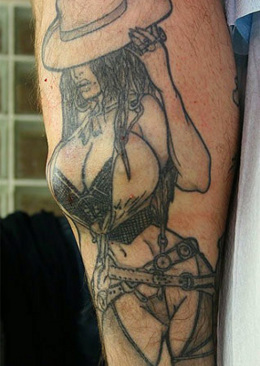
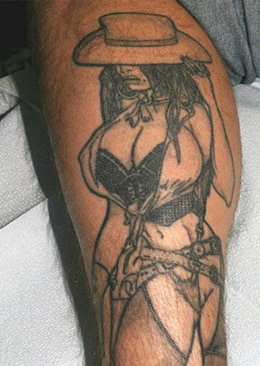
Canadian Lane Jensen made a radical move to have one of the most bizarre operations of the year — to insert silicone implants not in his chest, but in his leg.

before after
Before Now with chesty goodness

A devotee of body art already, Lane had a tattoo of a large busted lady on his shin. He felt the tattoo wasn’t entirely dramatic enough, so he had silicone implanted underneath the breasts on the tattooed woman to make the inkwork more effective in the right areas.

“I thought for sure I’d be light headed or sick from the visual but in fact, after 15 minutes I sat up and watched. Today it doesn’t feel any worse than a minor bruise. It looks great and accents the tattoo very well.” said Jensen.

“My leg breast implants are doing great 1 week after the implant was inserted. The one spot where the nipple rubs against my pants is a little sore. It’ll callus up and be fine soon.” he adds.

UPDATE:

The implants were put in on December 9, but by Christmas Eve the sutures had split, and large quantities of lymphatic fluid were oozing out of his leg, Lane told the Edmonton Sun. “There was so much fluid in there. I went back to the studio and pushed on it gently — the implant shot right out.” He says that there was nothing wrong with the implant procedure. “My body just rejected it. I guess my girl wasn’t meant to have 3D breasts.”

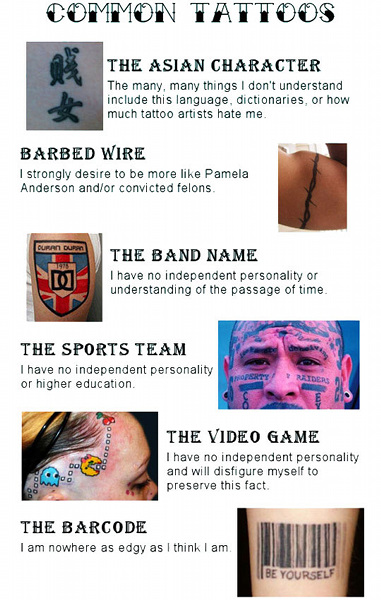
And, as a further treat, I present:


What your tattoo says about you

uncategorized

This is why you always *think* before you get inked

Posted on June 23, 2009June 23, 2009 By admin 1 Comment on This is why you always *think* before you get inked

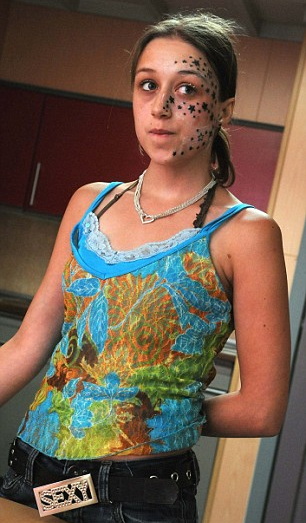
Girl with 56 stars tattooed on face admits she asked for them

A teenage girl who claimed 56 stars were tattooed on her on her face as she slept when she asked for three has admitted she was awake the whole time – and lied because her father was “furious”.

stupid girl

Kimberley Vlaminck had insisted she dozed off after asking the tattooist for just three small stars – then woke in horror to find her face was covered. The Belgian blamed the Flemish-speaking tattooist for not being able to understand her French and English instructions.

Amid a frenzy of media attention, she then pledged to sue the tattoo artist, Rouslan Toumaniantz, for the £9,000 she needed for laser surgery to have them removed.

She said after the tattooing last week: “It is terrible for me. I cannot go out on to the street. I look like a freak.”

But the 18-year-old has finally confessed she did not fall asleep, that she wanted all the stars and was “fully aware” of what Mr Toumaniantz was doing. Ms Vlaminck told a Dutch TV crew: “I asked for 56 stars and initially adored them. But when my father saw them, he was furious. So I said I fell asleep and the that the tattooist mad made a mistake.”

Mr Toumaniantz – himself covered from head to foot in tattoos and piercings – had consistently denied he had made a mistake and always insisted Vlaminck wanted all 56 stars. He said at the time: “I maintain that she absolutely agreed that I tattoo those 56 stars on the left side of her face.”

But despite insisting she had asked for 56 stars, he still initially agreed to pay for half of the treatment to remove the tattoos. He said: “Kimberley is unhappy and it is not my wish to have an unsatisfied client. I don’t regret it. To tell you the truth, this has given me some publicity.” Mr Toumanaintz is now said to have withdrawn his cash offer and said from now on he will get written consent from clients before he begins tattooing.


I’m sorry, but the girl is an idiot precious-snowflake-attention-whore. Remember kiddies, this is why you actually need to think about the consequences of getting tattooed and that it pays to reflect on what you’re actually getting inked onto yourself. I have ink. I do not regret it at all. I want more, and I think that the design that I want is starting to percolate towards a solid concept. Just remember this:

ganked from cracked.com

uncategorized

It’s not broken, don’t fix it.

Posted on April 30, 2009 By admin

Top Gear may be forced to hire new presenters as part of a government push to make the show more gender and ethnically balanced. This week the Equality Bill was introduced into Britain which encourages employers to take “positive action” to widen diversity in the public sector workforce. Top Gear, along with a number of shows funded by the BBC, now fall under the Bill.

There has been pressure on the boys who review their mechanical toys to change, with a leading academic earlier this month saying that the BBC should employ more women to help make shows such as Top Gear “female-friendly”, reports London’s Daily Mail.

Dr Louise Livesey, tutor in sociology and women’s studies at Oxford, accused Top Gear of “entrenched, institutional sexism”. As well as being hosted by Jeremy Clarkson, Richard Hammond and James May, the car show has a “boys’ club” production team and fewer female than male guests, it was claimed.

But Top Gear executive producer Andy Wilman claimed it was “utter drivel” to suggest that the show excluded women, saying: “If the show is allegedly female-unfriendly, why is almost half the audience female? Secondly, if we are to have a female presenter just to represent the sexes, then by that logic Loose Women needs a bloke in the line-up pretty sharpish. I actually believe these sorts of mandates are patronising to women viewers, because they assume that women can’t enjoy a show’s presenters on merit, but can only appreciate a program if spoken to by one of their own sex.”

Top Gear is one of the most successful and popular shows on the Beeb. It’s not broken. The formula works. Leave it the hell alone.

uncategorized

Posts pagination

Previous 1 … 4 5 6 … 17 Next

Power to the beaver!

Show me the beaver!
June 2026
M T W T F S S
1234567
891011121314
15161718192021
22232425262728
2930  
« May    

Quote of the day

He hated being thought of as one of those people that wore stupid ornamental armour. It was gilt by association.
--(Terry Pratchett, Night Watch)

Random Posts

  • Yoinked online
  • Montreal will do me good
  • Last sushi for a while
  • I'm perverted. Really, I am.
  • When laptops go bad
reading leopard

Tags

bobble the little blue owl boobies brought to you by the fda cats chonk christmas comics computers are evil covid-19 dealing with idiots dilbert dog ducks galleries geek god bless the land of the free holidays house I am Canadian land of cheese and chocolate linked news lolcat london news from the stupid not my dog nsfw pets pictures potd2014 qotd random shit re-member recipes relationship shrill slice of life stress Tao the british way The Peanut things i miss travel video wine work

Archives

Meta

  • Log in
  • Entries feed
  • Comments feed
  • WordPress.org

Copyright © 2026 The beaver is a proud and noble animal.

Powered by PressBook Premium theme